Category Archives: Life in the Army

D DAY 75 YEARS AGO

This was originally published in The Belle Banner, Belle Missouri June 6th 2018. If you would like to see the current articles as they are published, you may subscribe to The Belle Banner by calling 573-859-3328, or email tcnpub3@gmail.com, or mail to The Belle Banner, PO Box 711, Belle, MO 65013. Subscription rates are; Maries, Osage, and Gasconade County = $23.55 per year, elsewhere in Missouri = $26.77, outside Missouri = $27.00, and foreign countries = $40.00.
On June 6th 1944, 75 years ago, the United States of America led the way in changing world history. In June 1944 Hitler’s Nazi German army occupied almost all of Europe, including France. In order to push the German army back into Germany and defeat it, the Allies (primarily the United States, Britain, and Canada) had to get a foothold on the European Continent, they had to do a beach landing invasion. Hitler also knew that, and he was convinced that the invasion would happen at Pas De Calais, France (pronounced “Pa Dee Calay”). Pas De Calais is located on the French coast opposite England on the narrowest part of the English Channel. The Allied forces encouraged that idea by running Operation Fortitude, which was a giant intricate plan of deception to convince the Germans that the invasion would happen at Pas De Calais.
The entire coast line of France was fortified and heavily defended by the German Army, plus the Germans had around 40 divisions in France which could move in any direction. A large part of the German Army was armored. Tanks which could move fast. Pas De Calais was the quickest way to get from England, where the allied forces were staging and training, but it is located on a peninsula which would have made it easy for the German army to cut off an invading force. The Normandy area of France was chosen because it has several beaches on a wide front, which provided enough room to land an invading force large enough to get established on the shore. The invasion area was over 60 miles wide. Normandy is also on a peninsula, the Cotentin also known as the Cherbourg Peninsula, but it is a much larger area. In 1942 when the planners started developing the invasion plan they looked at the Cotentin Peninsula. A spider web of roads connects the towns and villages across the peninsula. At the center of that web is the town of Sainte-Mère-Église. Five roads pass through the town, plus it is only seven miles from Utah Beach. Control Sainte-Mère-Église and they felt that they had a good chance of controlling the Cotentin Peninsula and preventing German reinforcements located at Cherbourg in the north and Brittany in the west from reaching the beaches. The flanks of the invasion area had to be secured, if not, German tanks could have swept into the invasion area and possibly have defeated the Allied forces on the beaches. The only way to get forces into the invasion area before the landings from the sea was with airborne troops (paratroops). The specific mission of the airborne forces was to block the approaches to Utah Beach. There were two areas of higher ground on the flanks. The 101st Airborne Division was assigned to the high ground overlooking the beach with primary objective of securing four causeway exits from Utah Beach, which were to be used by the 4th Infantry Division to move off of the beach.

82nd Airborne paratroopers chute up before loading planes in England June 5th 1944

The 82nd Airborne Division was assigned to the ridgeline centered at Sainte-Mère-Église, with the mission of blocking the German armor from coming into the invasion area. The 82nd Airborne Division mission was key to the success of the entire invasion, it could not fail. Many senior planners for the operation felt that the 82nd had no chance of obtaining its objectives. Some said that it was a suicide mission. General Eisenhower gave them a 50-50 chance for success.The 101st Airborne Division had not seen combat, it was shipped to England in the fall of 1943 to train for the invasion of Europe. It was commanded by Major General Maxwell D Taylor, who had been promoted to two stars and moved from the 82nd Airborne Division Artillery in March 1944 after the 101st commander Major General William Lee suffered a heart attack.
The 82nd Airborne Division was commanded by Major General Matthew Ridgeway, who had commanded the division in combat in Sicily and Italy. The Assistant Division Commander was Brigadier General James M Gavin, who at 37 was the youngest general in the army, and as a colonel had led the 505th Parachute Infantry Regiment on night parachute jumps into combat in Sicily and Salerno. Ridgeway and Gavin knew from experience that their paratroops would be scattered upon landing, so they conducted their training with that in mind. They conducted night training jumps until injuries became too numerous, then they trucked the troops out into the field, at night to train for taking objectives, but they would mix-up the units. They had organized competition in football, basketball, volleyball, and baseball, but they couldn’t play unit against unit. Teams had to be players from different units, such as three from A Company, 1st Battalion, three from C Company, 2nd Battalion, and three from D Company, 3rd Battalion. They wanted the paratroopers to learn to trust each other, even if they didn’t know each other. They also gave the paratroops lots of free time, which was spent by most of them in the bars in the local villages. The troops would have plenty to drink and get into fights sometimes between the 82nd and 101st, but mostly between the paratroops and the legs (non-airborne soldiers). The military police would come to the generals and tell them that their paratroopers were getting out of hand, they needed to do something, and the generals would say; “OK, we’ll look into it”, and nothing happened. They wanted the paratroopers to be full of bravado, gusto, and aggressiveness.
The 82nd was organized into two elements for the assault. Force A, which was the main combat element, was commanded by Brigadier General Gavin and consisted of three Parachute Infantry Regiments, with Artillery, Engineers, and Signal attached. Force B, commanded by Major General Ridgeway, consisted of a Glider Infantry Regiment and the remainder of the divisions’ Artillery, Engineers and support elements. So, after all the equipment and ammunition had been issued, knives and bayonets sharpened, last letters written home, faces blackened with burnt cork, and last prayers said, Force A took off in England at 11:15 PM, June 5th 1944. Three five man pathfinder teams jumped in 30 minutes ahead of the main element. They sustained casualties, but still managed to set up beacons to guide the incoming aircraft. The 378 airplanes carrying Force A kept good formation across the English Channel, but ran into a fog bank between the beach and the three drop zones, which caused some to move out of the formation, then anti-aircraft fire opened up and when planes started getting hit and shot out of the air some pilots panicked and started trying to evade. Some scattered and some were flying too high and faster than they should have been at jump time. One lieutenant said that when his plane ran into heavy flak, the pilot panicked, turned on the green light and started climbing at full throttle. The lieutenant said that the prop blast was so strong that all his equipment was ripped off of him, when he got to the ground the only weapon he had was his jump knife. The first jumpers went out the door at just before 2:00 AM and all were on the ground by just after 3:00 AM. The gliders started crash landing about 4:00 AM. Both paratroops and glider troops were scattered.

82nd Airborne paratroopers jumping into France about 2:00 AM June 6th 1944

The 3rd Battalion 505th Parachute Infantry Regiment, of the 82nd, got the mission of taking the town of Sainte-Mère-Église. Their drop zone was planned just outside the town, but many landed directly on the town. There was a house fire in Sainte-Mère-Église which lit up the sky and made the paratroopers very visible, plus the Germans were already alerted because two planes of 101st Airborne paratroopers, wildly off course, had dropped on Sainte-Mère-Église just 30 minutes prior to the 505th jumping. Many were killed in the air, if they got caught in trees or lines, they were killed, at least one landed in the house fire, and two got caught on the church steeple. Within an hour Sainte-Mère-Église was firmly secured in the hands of the Americans. The American flag was raised making Sainte-Mère-Église the first French town liberated by the allies.
Out in the countryside on the ground, a little group of paratroopers would get together, the ranking man would take charge and start trying to find their unit or their objectives, but they engaged the Germans wherever they found them. They conducted ambushes, they attacked bridges and road intersections and generally created havoc, causing the German commanders to think they were facing a much larger force than was actually there. The 82nd and the 101st accomplished all their objectives, but the cost was high. Each division jumped just over 6,500 paratroopers and each division suffered about 20 percent casualties, but the strategic importance to the overall success of the Normandy invasion was huge. Those two Airborne Operations are still considered two of the most daring in the history of modern warfare.
The following is a quote from 82nd’s After Action Report of the Normandy action; “Enemy reaction to the landing of the 82d Airborne Division in the NORMANDY area was prompt and severe, but from the time the first member landed until 35 days later, when the Division was finally relieved, every mission was accomplished and no ground gained was ever relinquished.”
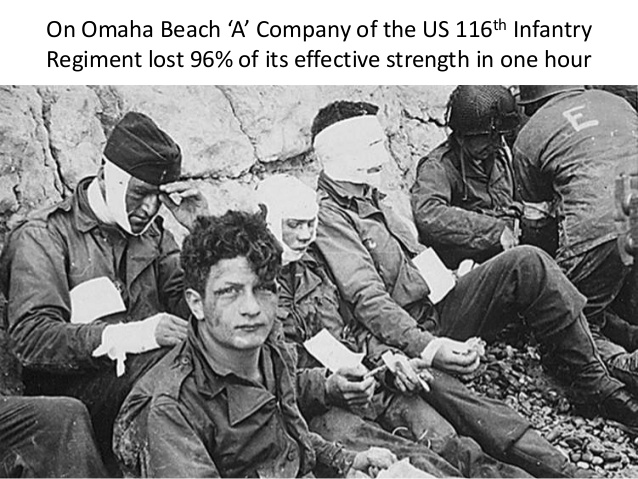
Throughout the day of June 6th 1944 over 5,000 ships and 13,000 aircraft delivered about 176,000 troops onto the beaches of Normandy.

Over 4,000 of them died on the beach and another 6,000 were wounded, but they captured the beaches and the seaport of Cherbourg, establishing the Allied forces in France with a solid beach-head, from which they would begin the push across France and into Germany.

“The Longest Day” is a four star movie about D-day. It was written by Cornelius Ryan, who was a war correspondent in World War II. It is one of the best and most historically accurate movies about that day.

JUST SOME ARMY STORIES

This was originally published in The Belle Banner, Belle, Missouri on June 13th 2018.
This is just some war stories, but not the kind that is conjured up by the term “war stories”, so I’ll just call them “Army Stories”. Some are funny, some are not, some are funny only to the people involved, some are just interesting, but they are about life in the Army.
A Rifle Platoon Sergeant in the infantry runs a platoon of about 40 soldiers. The Platoon Leader, the lieutenant, leads the platoon. In the infantry, Rifle Platoon Leader is the very first assignment (job) a new lieutenant gets, after he has completed all of his initial training. In the field the Platoon Leader leads and directs combat operations and the Platoon Sergeants’ job is officially beans and bullets. Making sure that everyone has what they should have. Unofficially one of the Platoon Sergeants’ primary jobs is to train his lieutenant. Good Platoon Sergeants understand that and take it as a responsibility. Good lieutenants also understand it and welcome the years of experience from their platoon sergeant. Most of the time that works very well, sometimes it doesn’t.
One of my platoon leaders graduated second in his class at West Point. He was extremely smart, but he knew it and thought that he was smarter than everyone else. I also had a new lieutenant who had grown up in the Army. His father was a Colonel and his wife’s father was a Colonel. He graduated from ROTC, and he was completely familiar with army life. He was all open and eager to learn. Shortly after he arrived, our company commander (Captain) took him to a briefing at Battalion Headquarters for an upcoming operation. When the briefer said; “This is a joint exercise, so when you call for tac air (meaning tactical air support, i.e. jet fighters attacking positions you are requesting them to attack), you get tac air. My lieutenant blurts out “Ohh WOW”!!. The captain said, “shut up …..” listen to the briefing”. He was a good lieutenant, he would listen to anyone who made sense. The troops liked him, and when the troops like a lieutenant, look out. When the troops don’t like a lieutenant, they leave him alone, but when they like him, and they consider him one of them, he is free game. Somehow exlax got into his canteen in the field. I don’t think he ever knew why he had problems on that field exercise. I found out later, but not who did it. I was proud of him, because in six months he was moved to be Platoon Leader of the Battalion Reconnaissance Platoon, which is usually reserved for the best infantry lieutenant in the battalion.
During a training exercise, my company jumped into Sardinia in 1978 and made CBS evening news. About 120 paratroopers jumped that day, we had over 30 injured including a couple broken arms, mild concussions and one broken leg. When my parachute opened I thought for a second that I was disoriented because the wind wasn’t right. Then I realized that it was the wind. The wind was way too strong for a parachute jump. We had MC1 steerable chutes with hand toggles, very maneuverable, and you always face into the wind when landing. The wind was so strong that it was pushing in on the wind side of my canopy. I hit the ground heels first, did a backward flip through my suspension lines and went about 50 yards through a briar patch before I could release one side of my canopy. Nothing hurt. Our First Sergeant who had spent 20 years in Special Forces and had jumped in all kinds of adverse conditions, realized what was happening and released his canopy the second he hit the ground. We stopped the war gaming long enough to get the injured treated and separated into those who could continue and those who would be evacuated back to Italy or to a hospital in Germany. One of my Squad Leaders, a Staff Sergeant named Joe, really got his bell rung. When we finally gathered to move out, Joe had that horizon blank stare in his eyes, wasn’t walking steady, and didn’t seem fully aware of what was happening. We sent Joe back to Italy and it was a couple days before he was completely normal.
A formal investigation following that jump discovered what had happened, and caused a change in drop zone control. On every training parachute jump there was a Drop Zone Safety Officer and a Sergeant assistant, usually from the unit jumping, and an Air Force Tactical Air Control Team. They had wind machines to monitor wind speed and direction. Training parachute jumps are allowed in wind speeds up to about 12 knots, wind speeds of 13 knots (about 15 miles per hour) or over usually cancel the jump. The drop zone for that jump was about 3,000 meters long and was next to the ocean. The drop zone control party had set up at the lead end of the drop zone, which was normal, be where the jump starts. They were monitoring winds of 11 to 12 knots, which were approaching borderline, but still within safe jumping conditions. However, about halfway down the drop zone the ground was slightly higher catching the strong ocean winds. After that, drop zone safety teams had to survey the entire drop zone. The general consensus was that we jumped in 35 to 40 mile an hour winds.
The Army started using GPS, just like everyone else, especially in Iraq, except what the military uses is much more accurate and reliable than what civilians get to use. And the Army apparently became so dependent on GPS that it was ignoring plain old land navigation with a paper map and a compass. Because in the past couple years there has been a renewed and increased emphasis on teaching and testing land navigation. If technology breaks down, soldiers on the ground have to be able to navigate. This is one of my land nav stories. During a war gaming exercise in mountains in Norway my company was in the process of getting everyone in position to start the exercise. My platoon was the first to arrive in the area and get in position. Another platoon was to be located a couple mountains west of us. Our Company Commander (CO) ask me to go with him, via helicopter, to show me the location of the other platoon, because he had to go to a meeting. When the other platoon arrived I jumped in the bird with the Platoon Leader and rode with them to their location. The helicopters dropped us and left. After I pointed out the parameters of the location to the Platoon Leader and Platoon Sergeant, I had nothing else to do there. My platoon was located about three kilometers away, on the map. In mountains that can be a long way. It was late afternoon and the sun was already very low, but I wanted to be with my platoon. My Platoon Leader was a good lieutenant and very competent, but I wasn’t there. I had a map, a compass, and a radio, so I started home. By the time I got down the side of that mountain it was dark and no moon. As I got back on high ground I could see a house light in a valley in the distance and the lights of a car on a road travel from left to right past that house. Our platoon radio operator, Specialist White, was as sharp as they come and was with my platoon. White could also see the house light. Every time a car moved on the road White gave me the azimuth when the car moved between him and the house, I checked my azimuth. After several hours of sliding down banks and climbing up them and running into trees, our azimuths were getting very close. Finally I sat down and waited for the next car, we were on the same azimuth. I sat there for a few minutes contemplating my next move when I heard someone cough. I asked White if some just coughed, they did. They were about 50 feet to my rear.
One of the best infantry company commanders (CO’s) I served under, also had a great sense of humor. When playing army in the field, blank ammunition is used in rifles and machineguns, at that time blanks were not manufactured for .45 caliber pistols. Our CO disagreed with a captain in our battalion operations section about a certain aspect of the current field exercise. Our captain wrapped an M-16 blank cartridge with duck-tape until it fit perfectively in his .45, and when the headquarters captain visited our company command post, in the field, to discuss the exercise, our captain started an argument. The argument heated up, and our captain stepped back and said; “If you don’t like it, I’ll just shoot you”. And BANG, a blank fired in a pistol sounds very much like the real thing. For a few seconds there was no sound, only big eyes and open mouths, then laughter and finally laughter by all, and the disagreement was resolved.
One time I was working for a colonel when he was promoted to brigadier general. When he was first promoted he would come in the office laughing about his new experiences. He always drove to work in his PT (Physical Training) clothes, sweats or shorts and T-shirt. One morning he was stopped at a routine Military Police check point. The young MP checking licenses and ID cards asked, “Sir, what does “BG” mean?” He answered, “That means Brigadier General.” The young man said, “I was afraid that’s what it meant.”

$40,000 ENLISTMENT BONUS TO BE A GRUNT

This was just published in The Belle Banner, Belle, Missouri, on May 15th 2019. I want to get this information to as many as possible while the bonus is still current.
If you’ve ever heard the saying “He’s just a lowly grunt”, discard it, there is no such thing. The infantry soldier is at the top of the heap – the pinnacle of soldiering. The infantry moto is “Follow Me”. Every element of the military supports the infantry. Infantrymen are the combat soldiers, whose job is to close with and kill or capture the enemy. They are the warriors.
Upon successful completion of infantry training, the soldier is awarded a blue infantry cord to wear on the right shoulder of dress uniforms and blue backgrounds for lapel insignia, one of which is the crossed rifles of the infantry. That is the “Turning Blue Ceremony”. In permanent units infantry soldiers may voluntarily participate in a week and a half long, rigorous test of all infantry skills. Those who successfully complete all tasks in the time allotted are awarded the Expert Infantryman’s Badge (EIB), a rifle on a blue background, to be worn on all uniforms. Infantrymen who see combat are awarded the Combat Infantryman’s Badge (CIB), which is the same badge, but with a wreath around the rifle. The CIB is the most prestigious badge worn on a military uniform.

Turning blueExpert and Combat Infantryman Badges

Army infantrymen, and women, are trained in OSUT (One Station Unit Training) companies on Sand Hill at Fort Benning, Georgia (Columbus). OSUT companies conduct basic and advanced training all in one company. About half of the women who have started infantry training have made it through. Some are now in infantry units and this past year a few in the 82nd Airborne Division won EIB’s. Women must do the same physical tests and activities as the men. Not many women want to be infantry grunts, but some do and some make it through.
The Army is trying to increase its size, but the current Army leadership has seen, in the past, the bad results of lowering standards to get more recruits. Standards are not being lowered and training is being increased. Infantry OSUT is being expanded from 14 to 22 weeks. A pilot 22 week class graduated in December, and the program of instruction is being finalized to be fully implemented by this coming October. The commanders and drill sergeants who conducted that pilot class said that they didn’t try to come up with many new tasks, but were able to spend more time on the basics and produce a better trained soldier. They spent more time in live fire and produced more expert riflemen, they had 100 percent successfully complete the land navigation tests, our enemies have digital technology so infantrymen must be able to navigate with a paper map and compass, the class completed the combat lifesaver course, they spent much more time in hand to hand combat training, and the extra two months produced graduates in better physical condition. The Infantry Training Brigade commander said, “If we do our job right these troops will be able to out PT their team leader and out shoot their squad leader, and be as good or better than their combat life savers.”

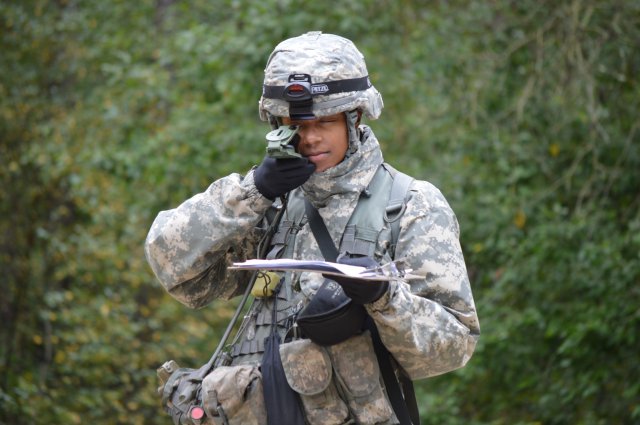
Land navigation with map and compass

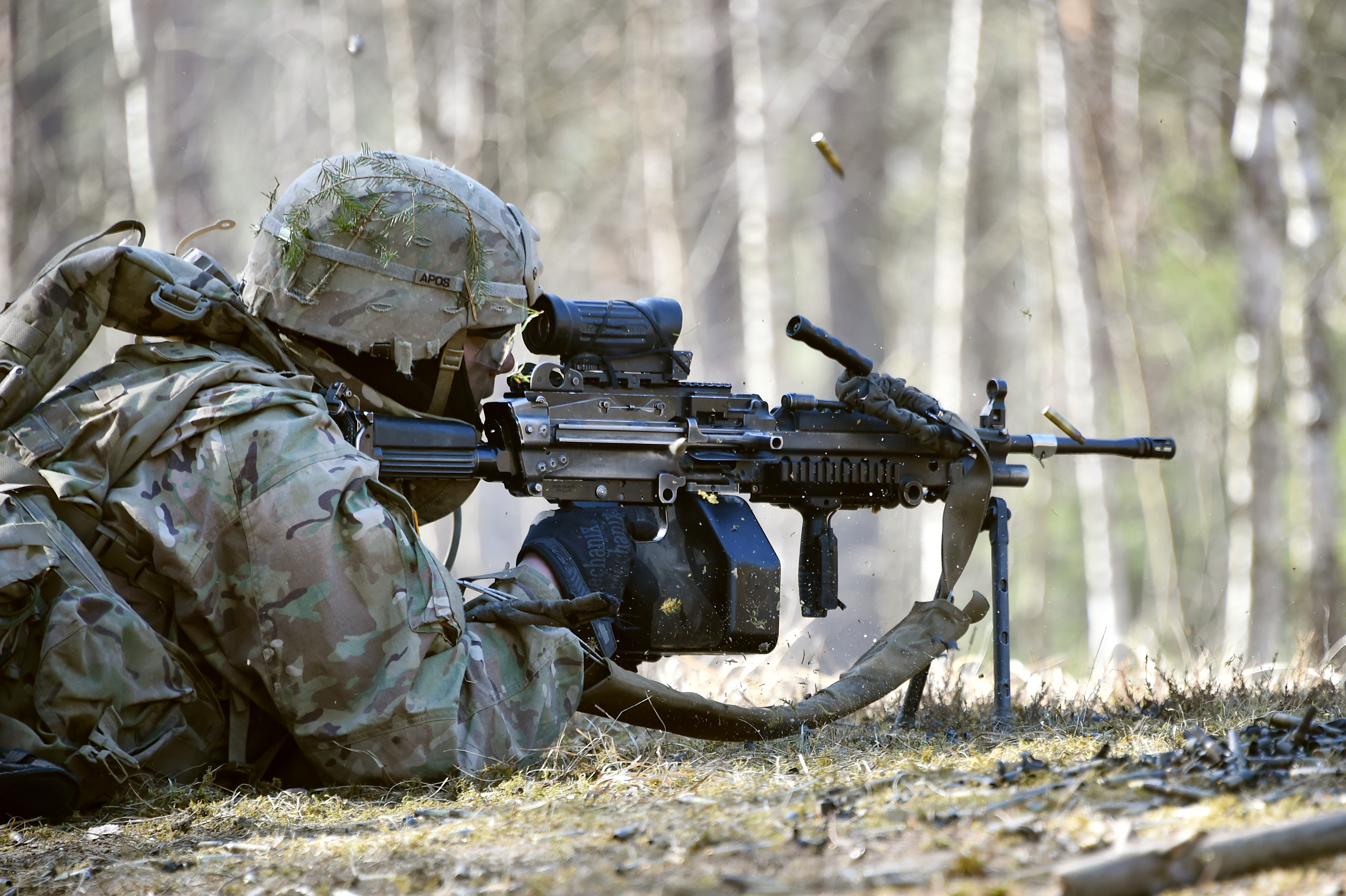
More live fire

The infantry works harder, the infantry goes to combat, there is more pride in the infantry, and the infantry gets promoted faster.
The enlistment bonus is $20,000 for a 3 year enlistment, $25,000 for 4 years, $30,000 for 5, and $40,000 for a 6 year enlistment. The soldier would be paid $10,000 after successfully completing infantry training, and the remaining divided by years of enlistment and paid annually. That is for someone enlisting for MOS (military occupational specialty) 11X which is infantry training. The infantry MOS’s are 11B Light Weapons Infantryman and 11C Heavy Weapons Infantryman (mortars). The Army decides which a recruit is trained for while he is in training. There are a whole lot more 11B’s that 11C’s. There are also two different types of infantry units. Mechanized, where infantrymen ride on or in some type of vehicle, and Light Infantry where they walk more than ride. Infantry soldiers may serve in either.
Infantry OSUT is no walk in the park. Basic Combat Training, which is the first 10 weeks, is tougher and more demanding now than it has been since World War II. Then the 12 weeks of infantry training is the most physically demanding MOS training in the Army. So my advice to anyone considering this, man or woman, is to get in shape, pushups, pullups, situps, running, and a lot of walking in boots (army boots if you can get them) carrying a rucksack. There are road marches of 3, 6, 9, 12 and finally 15 miles carrying a 60 pound rucksack. People who enlist for Rangers or Special Forces go to infantry OSUT first. I do not recommend that anyone who is not already very familiar with the Army enlist for Rangers or Special Forces. Enlist for Airborne Infantry, then when you’ve been in the Army long enough to know what those units actually do and their requirements, make your decision. The first three weeks are “Total Control”, trainees don’t make a move that is not guided by a Drill Sergeant. That is when they learn how to march, stand, turn, salute, and act like a soldier. After that the control is a little different, but the intensity isn’t. An infantry OSUT company commander recently posted on facebook for families not to expect many phone calls, communicate by mail.
The infantry unit with the highest morale (happiest) in the military is the 82nd Airborne Division. The 82nd also works the hardest, because one the 82nd’s three brigades is always on alert to get the entire 5,000 man brigade with all vehicles and equipment, rigged for a parachute drop somewhere in the world, in the air within 18 hours of notification. Because the 82nd is America’s Fire Brigade, it is always fully funded, conducts realistic and exciting training, and has the best leadership the Army has to offer. There is a saying that when the President calls 911 the phone is answered at Fort Bragg, North Carolina. There are actually two unofficial separate armies within the US Army. There is the Airborne Army and the non-airborne army. Young airborne troops, paratroopers, un-affectionately call the non-airborne army “legs”. A person who enlists for 11X with the airborne option will probably go to the 82nd, or possibly the 173rd Airborne Brigade (The Sky Soldiers) in Vicenza, Italy. Vicenza is currently, by survey, the most desired assignment location in the Army. Our own Command Sergeant Major Jeremy Compton is there now. There is also the 4th Brigade (Airborne) of the 25th Infantry Division at Anchorage, Alaska.
Airborne infantry is light infantry, but their method of delivery to the battlefield causes them to train differently than non-airborne. Non-airborne infantry gets to the battlefield on a vehicle or a helicopter, airborne jumps from an airplane onto the battlefield. Adverse weather or enemy anti-aircraft fire can cause airplanes to drop paratroops not at their planned location. Individual paratroops can become widely scattered during a jump. I can tell you what happens when paratroops are dropped in 35 mile an hour winds. Made national news that time. Because of that possible scenario airborne troops are briefed down to the last Private on the entire mission and objectives. That started in World War II and continues today. When time permits the entire platoon gets to see aerial photographs and mock-ups. The airborne has a term LGOPS (Little Groups of Paratroopers). If a paratrooper can’t find his leaders, he just finds other paratroopers and goes on with the mission. The first combat parachute jump was in Sicily in July 1943. Due to winds and enemy fire the paratroops were scattered over many miles in places they didn’t plan to be. Little groups got together and cut every telephone line they found, they ambushed vehicles and attacked troops causing the German commanders to think they were facing a much larger force than was actually there.

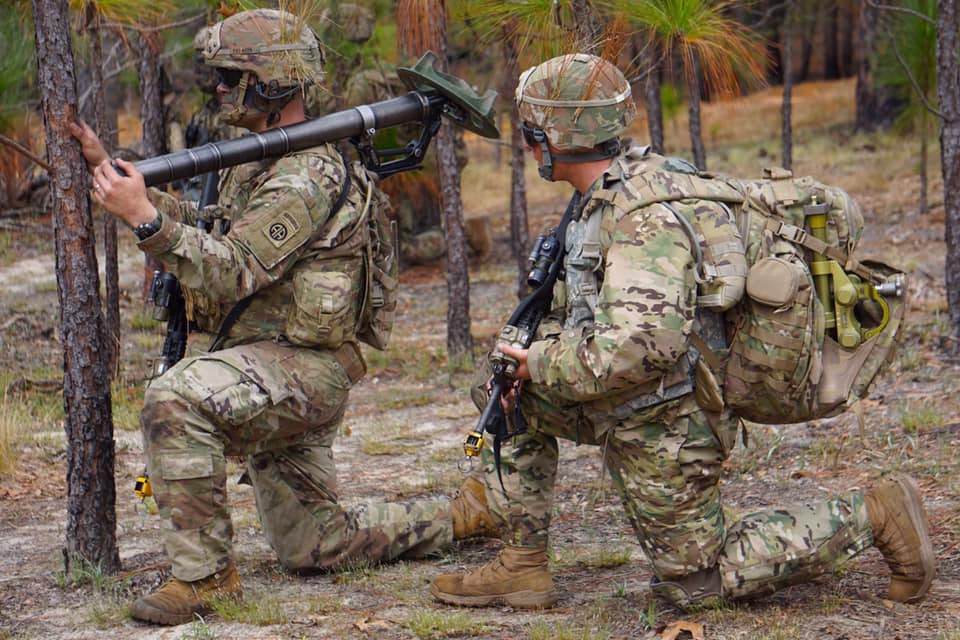
82nd Airborne 60mm mortar crew

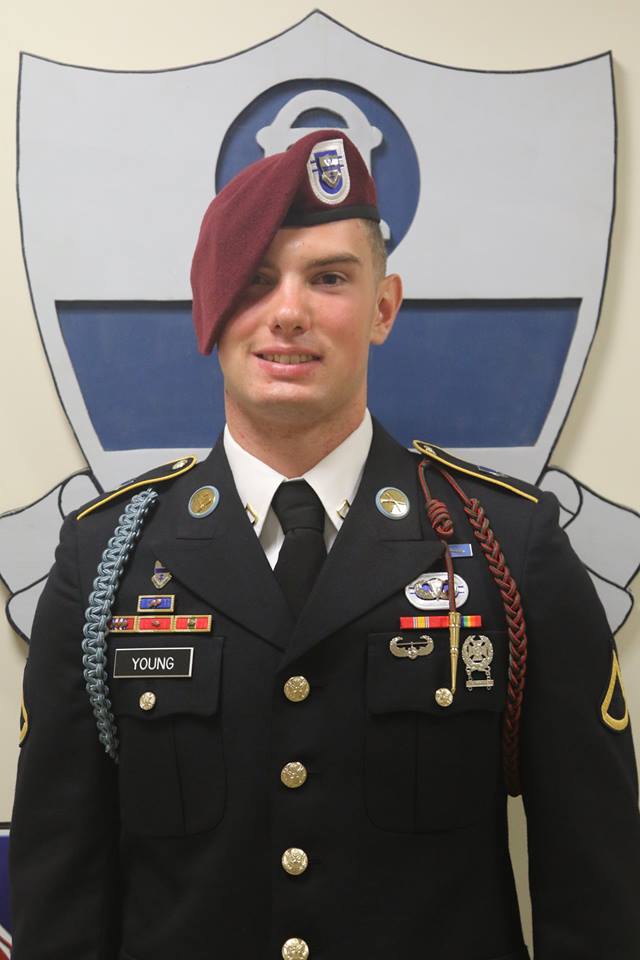
Infantry Private First Class Noah Young 2nd BCT 82nd Airborne Division Trooper of the Quarter
This bonus won’t last long. Go Infantry – Go Airborne $$$$!

NAVY

This was originally published in The Belle Banner, Belle Missouri December 27th 2017. If you would like to see the current articles as they are published, you may subscribe to The Belle Banner by calling 573-859-3328, or email tcnpub3@gmail.com, or mail to The Belle Banner, PO Box 711, Belle, MO 65013. Subscription rates are; Maries, Osage, and Gasconade County = $23.55 per year, elsewhere in Missouri = $26.77, outside Missouri = $27.00, and foreign countries = $40.00.
Young people who know very little, or nothing, about life in the military, and are considering enlisting, can find volumes of conflicting information. Recruiter’s jobs are to recruit people into their service. Most people who have been in the military, and consider it to have been a positive experience, are prejudiced to that branch. I am naturally prejudiced toward the Army, because I spent a career there and retired from the Army. During my time in the Army, I spent more time with the Air Force than with the Marines or the Navy. I rode in Air Force planes about a hundred times, but rarely landed with them, plus when I was at Fort Bragg, North Carolina, Pope Air Force Base was a large base on Fort Bragg. We did train with Marines occasionally, and spent some time on a Navy ship, while the Marines who were assigned to the ship slept on the ground.
I know from experience that the single best indicator of how satisfying or dissatisfying life is in a military service is the percentage of people who stay. Those who reenlist after their initial enlistment. The services are very reluctant to make those figures public. In 1998, before 911, the Army had 51 percent of first term enlistees staying in the Army, the Navy 55%, the Air Force 54% (down from 65 in 1995), and the Marines at 22 percent. All the services first term reenlistments spiked after the 911 attack in 2001, then declined as the wars and deployments increased. The Air Force dropped to below 35 percent in 2005, then went back up to just under 50 percent in 2008. The Navy dropped to below 25 percent in 2004, back up a little then down to 20 percent in 2007 and up to just over 25 percent in 2008. The Army spiked to over 30 percent in 2002, then dropped to 25 percent in 2003, but then climbed steadily to over 40 percent in 2008. The Marine Corps stayed at just over 20 percent from 2000 to 2006, then jumped to around 35 percent in 2007 and 2008, which tells me that conditions started improving, in the Corps.
I found that I couldn’t do justice to any service, if I tried to cover them all in one week, so this week is about the Navy, next week the Marine Corps, then the Air Force, and finally I will make my pitch for the Army. I’m starting with the Navy because it is apparently the least popular armed service for this area, and that is reasonable since we are in the center of the country and the Navy is primarily on water, big water.
The difference between life in the Army and life in the Navy is like night and day. The Army lives on land and the Navy lives on water. They have different missions, they have different lifestyles, and they have different languages. In the Army the floor is the floor and the ground is the ground, in the Navy it is the deck. Restrooms in the Army are latrines, in the Navy it is the head.
First, if you consider the Navy, you should be very comfortable with water. Not just be able to swim, you should swim like a fish. In boot camp, a lot of time is spent in the water, plus sailors spend roughly half of their time in the Navy on water, big water.
Enlisting in the Navy is different from enlisting in the Army, in that the Navy will guarantee an area, called a rating and there are sometimes many different specific jobs within a rating. What specific training a person receives within a rating is determined during Navy boot camp. That determination is made based upon ASVAB scores, training (in other words aptitude and attitude) and the desire of the individual, but ultimately on the needs of the Navy. Most Navy enlistees are guaranteed a rating. However, they are not guaranteed a specific school or job within that rating. That is determined during boot camp. Then after boot camp, they attend an “A” school to learn a specific job within their rating.
There is serious competition to get into the Navy, so high ASVAB scores, clean record, physical condition, and college all help in the enlistment process A person can also enlist in the Navy under a program called PACT, Professional Apprenticeship Career Track. There are three areas of the PACT program, Airman-PACT, Fireman-PACT, and Seaman-PACT. Under the PACT program, a person enlists in the Navy without a guaranteed school, but an assignment in one of the three PACT areas. After boot camp the Fireman and Seaman PACT enlistees attend a three week school at Great Lakes Naval Training Center, whereas the Airman PACT’s attend a three week school at the Naval Air Technical Training Center (NATTC) at Pensacola, Florida. They are then assigned where ever the Navy needs that type of sailor. They are assigned to general duties and they are entered into a monitored general apprenticeship program for some formal training and on-the-job training. Between 12 and 24 months they must submit a PACT designation application for an “A” school.
All Navy Boot Camp (basic training) is conducted in one location, at the Great Lakes Naval Training Center, on the shore of Lake Michigan, halfway between Chicago and Milwaukee. It is officially called RTC (Recruit Training Command). The first week is all processing, then there are eight weeks of boot camp. The Army has Drill Sergeants, and the Marines Drill Instructors. The Navy call theirs RDC’s (Recruit Division Commander). During the first week recruits take their initial swim test. They must pass a 3rd Class Swim Test before graduating from boot camp. The third class swim test consists of TWO modules. Module one is composed of three separate events, a deep water jump, a 50-yard swim (using any stroke), and a 5-minute prone float. Swimmers who successfully pass module one may continue on to module two. Module two consists of shirt and trouser or coverall inflation. A 3rd Class Swimmer is described as a person who can stay afloat and survive without the use of a Personal Flotation Device (PFD) in open water under optimum conditions long enough to be rescued in a man-over-board situation.
There is plenty of marching, physical training, classes on military courtesy and history. The Confidence Course is in the second week. In the Confidence Course recruits wear OBA’s (Oxygen Breathing Apparatus), carry sandbags, toss life rings, and climb through a scuttle ( a small circular door) with full seabags. It is not an individual event. It’s a team effort, in groups of four. The object is to cross the finish line as a team, not as individuals. The third week is ropes and knots, basic line handling skills. The first three weeks are a “shock” treatment, just like in the Army or Marines, nobody can do anything right. Around the third or fourth week, the RDC’s get a little more human, and the recruits realize that the RDC’s really are concerned about getting them through boot. Morale goes up and they start having fun. Week four is the initial PT (Physical Training) test. The PT test consists of push-ups, sit-ups, running/or swimming, and a sit-reach, which is sitting on the ground with legs stretched out front, knees straight, and toes pointed up. Without jerking or bouncing, you lean forward and touch your toes with your fingers for at least one second. You get three tries. The fifth week is classroom, firing range, and computer. They fire 40 rounds from an M-9, 9mm handgun, also fire a Mossberg 12 gauge shotgun. There are computer classes on the Navy Knowledge Online website. Week six is the protective (gas) mask and the gas chamber, and training on damage control in shipboard emergencies. Week seven is Battle Stations Week, consisting of live fire test at the range, final PT test, and Battle Stations Test. Week eight is graduation.
The Navy has some 51 major bases in the continental Unites States, plus bases in Hawaii, Bahrain, Italy, Cuba, Greece, Guam, Japan, South Korea, Spain and England. Many Navy assignments are not actually to bases, but to a ship or submarine, which considers the base its home port. Nearly all are at a beach. Depending on the job, sailors apparently spend about half their time on a ship and half on shore, but that is not absolute. Those in the Navy Nuclear Power Program will spend almost all of their time on an aircraft carrier or a submarine.
Including reserves, the Navy has 459 ships total, 201 of those are commissioned ships, the USS ships, carriers, destroyers, cruisers, command ships, etc. There are 52 Attack Submarines and 14 Ballistic Missile Submarines. There are an additional 41 ships under construction and 25 more planned. Life on board ship varies with the size and mission of the ship. There 11 Aircraft Carriers, 1 under construction and 9 more planned. An Aircraft Carrier is a quarter of a mile long, 4 ½ acre, 20 story projection of United States power. It has close to one hundred planes and helicopters, including jet fighters, which can be launched every 15 seconds. They carry a crew of between 5,000 and 6,000, most of whom work below deck. Only flight deck personnel are allowed on deck during operations. The flight deck of an aircraft carrier is considered the most dangerous job in the military, not involving actual combat. There are gyms, dental and medical clinics and hospitals on board, as well as college teachers teaching classes. Basketball and volley ball games are played in the hangers below deck. Space is for planes and work, not people, hallways and stairways are cramped. Personal living areas include a wall locker and a rack (bunk) just large enough to sleep in. Other than flight deck personnel, most time is spent below deck. On some ships there are “hot racks”, where more than one person is assigned to a rack, because of shift work.
Sailors who write positive comments say that it is a great adventure, and they like the travel. Overall sailors are proud of the Navy and generally enjoy their jobs. One sailor wrote that even at war they would be shooting missiles from 500 miles away, eating normal meals, taking daily showers, and living in an air-conditioned space. I’ve heard many infantry grunts say “those guys have got it made”.

BUCK AND BECKY ENLIST IN THE ARMY TOGETHER

This was originally published in The Belle Banner, Belle Missouri January 23rd 2019.
I recently wrote about a fictional couple of young lovers, Jack and Judy, who got married after high school and Jack enlisted in the Army. Well this story starts with the same scenario, but with a different twist. Buck and Becky are two adventurers who get married and both enlist in the Army. Although the Army does not guarantee that married soldiers will be assigned together, it has a program to try to insure that they are. The only couples I found not assigned together were where one or both had weird jobs only performed by a few in specific locations.
Their plans for life are to get good college educations, get good jobs and live a good life. If they both spend three years in the military, their education will be paid for with the GI Bill. It would also mean they could get married, live comfortably, and have a great adventure. Buck wants to jump out of airplanes and have some fun and Becky wants to go along for the ride and be part of it, and they don’t want to be separated. Becky doesn’t want to do some of the things that Buck is thinking about, and Buck doesn’t want anything tame. They considered different jobs, which would probably mean training at different posts. Buck would really like to be a grunt, but infantry training is basically 22 weeks of basic combat training at Fort Benning, Georgia. That plus processing time, plus three weeks of airborne school equals almost seven months, and Buck really loves Becky so that is just too long. They have been told that if they chose the same job it should be a “high population” job so that being assigned to the same place wouldn’t be a problem. The “high population” jobs trained at Fort Leonard Wood are military police, truck drivers, combat engineers, and CBRN (Chemical Biological Radiological and Nuclear). The only one that they would consider was CBRN. There is a CBRN Sergeant in every line company in the Army, whose job is to maintain the CBRN room with all the protective and detection gear, and conduct and supervise CBRN training in that company. Some support units don’t fully utilize their CBRN Sergeants, but they do in the 82nd Airborne Division. The AIT (Advanced Individual Training) is 11 weeks long with a lot of brainy classroom work and homework, which doesn’t please Buck, but at least they would be close. On the positive side, promotions are fast. Soldiers are currently being promoted to Sergeant at or around the two year mark. They want to be in the best unit with the best of people on the best Fort on which to live. That would be the 82nd Airborne Division at Fort Bragg, North Carolina. The 82nd is about 10 percent female with women in most jobs in the division.
If they ship together, they can be assigned to the same basic training company and go through basic together. As an old Drill Sergeant, I can tell you they would be in different platoons, as far apart as possible. It would not be comfortable seeing your wife or husband being treated bad, which does happen in basic training.
So, marriage, honeymoon, ship to the reception battalion, then 10 weeks of Basic Combat Training. Graduation then move down the street to MOS 74D CBRN Specialist AIT for 11 weeks. Another graduation then travel to airborne school at Fort Benning for the three week school.
In their planning they studied the Army’s Married Army Couple Program (MACP). They learned that they each have to submit written applications for that program while in AIT. Both will tell their AIT Drill Sergeants as soon as they arrive at AIT that they each have to submit an application for MACP. As “Future Soldiers” they will set up their AKO account (Army Knowledge Online), as soon as they have their ship date to basic training. Then as soon as they can get to a computer, after they are issued their military ID cards (now called Common Access Card) (CAC), they can set up their full access AKO account. That may be when starting AIT. Also in AIT they will go to the ASK (Assignment Satisfaction Key) on their AKO account and list their assignment preferences, the first being Fort Bragg. When their MACP packages are received and entered at Human Resource Command, they will be officially registered in the MACP, and considered for assignment jointly.
When their tentative assignments are listed on their AKO site, they will request a reporting date to their first assignment which allows them 10 days of leave after airborne school. Providing their reporting date allows it, their company commander in airborne school may approve up to 10 days leave before reporting to their unit. They will need the time to come home and get their cars and personal items and then arrive at Fort Bragg a few days before they have to report in. Fort Bragg always has on post family housing with “move in specials” immediately available, so they can get a house and arrange to get anything else they need before reporting in to their units. They plan to have sufficient savings, at that point to get whatever furniture they will need.
When they get married they will open a joint checking account. Along with birth certificates, marriage certificate, drivers licenses and original social security cards, they will take blank checks with them to process in to the Army. The military only pays by direct deposit. They will both be issued $350 debit cards to purchase necessary items. That money will be deducted from their first pay. The base pay in 2019 for a Private E-1 with under four months service is $1,554 per month and the military pays twice monthly. On the 1st and the 15th. Both would claim married with one dependent (themselves) on their W-4 when they process in, and assuming that they don’t take the full $400,000 Serviceman’s Group Life Insurance (SGLI), but only $200,000 each, after all deductions their net pay would be $659.56 per payday, with the $350 deducted from the first, after which each would have $659.56 deposited in their account twice monthly, or a total of $2,638.24 per month while in basic training. Shortly after arriving at AIT they would go over four months service, which would automatically increase their base pay to $1,680.90 per month. After 60 days in the Army they would automatically be enrolled in the Army’s Thrift Savings Plan (TSP), in which the soldier may contribute up to 3 percent of their base pay, which is matched by the government. So then, while in AIT even contributing three percent to the TSP, their net pay would be $679.94 per payday, or a total of $2719.76 per month.
They may or may not be advanced to Private E-2, whose base pay is $1,884.00 per month, at the end of AIT, but certainly when they arrive at their unit. Private First Class E-3, with a base pay of $1,981.20, would come within a month or two of their arrival. Married Army couples have another monetary advantage. They both receive Basic Allowance for Housing (BAH), which is determined by the location. At Fort Bragg, the with dependent rate is $1,134 per month and the without dependent rate is $984 per month. A married Army couple with no children both receive the without dependent rate. Living in on-post housing, Buck’s BAH would go to pay for the house, which includes all utilities, lawn maintenance, and trash pickup, and Becky’s would be theirs to keep. Plus, not living in the barracks, each would be paid $369.39 per month for meals. That is Basic Allowance for Subsistence (BAS). BAH and BAS are not taxed, airborne (jump) pay is.
Both being Private E-2, with $150 extra airborne pay, and living in government family housing, Buck’s pay would be $997.63 per pay day or $1995.26 per month, while Becky’s would be $1,489.63 per pay day or $2,979.26 per month, making their combined take home pay $4,974.52 per month.
Assuming that they each are promoted to Private First Class E-3 within a year, and to Specialist at about 18 months, and leave the service after three years, they each would have around $5,000 in the Thrift Savings Plan which could be rolled into an IRA.
I made Buck and Becky airborne because that is the proudest unit in the Army, but if they were not airborne, jump pay is only $150 per month each. So, wherever they were assigned in whatever job their take home pay per month would still be $4,741.48.
So how does a young couple prepare to do this? GET IN SHAPE. Get in the best possible physical condition. Start running, doing pushups, situps, pullups, and lifting weights, not presses, dead weights from a squat that uses your whole body, and walk, in boots – army boots if you can get them – if not good lace up boots, and walk carrying a rucksack with increasing amounts of weight. Basic Combat Training is hard, prepare for it. Also in preparation, study for the ASVAB. It may be easy for you, but study anyway. We don’t know the future, so you should score as high as possible on that series of tests.

EXPERIENCED WELDERS WANTED – IN THE ARMY

This was originally published in The Belle Banner, Belle Missouri January 30th 2019. If you would like to see the current articles as they are published, you may subscribe to The Belle Banner by calling 573-859-3328, or email tcnpub3@gmail.com, or mail to The Belle Banner, PO Box 711, Belle, MO 65013. Subscription rates are; Maries, Osage, and Gasconade County = $23.55 per year, elsewhere in Missouri = $26.77, outside Missouri = $27.00, and foreign countries = $40.00.
This story about the Army is from a different approach. This is for the person who already has a skill and becomes interested in service. People become interested in the military for a variety of reasons, patriotism, adventure, steady paycheck, security, etc. There is the Army Civilian Acquired Skills Program (ACASP), under which people may enlist at a higher rank and attend less training to become MOS (Military Occupational Specialty) qualified. Truck drivers, mechanics, EMT are some that fall within the ACASP.
This is directed at one group – welders. I was recently told by an Army recruiter that a person who has completed a welding school, is an AWS (American Welding Society) certified welder, and has two years’ experience, may enlist in pay grade E-4 Specialist. I know a couple people who fit that description, and welders are paid well so I ran some numbers. The 2019 base pay for grade E-4, with under two years of service is $2,194.50 per month. The military pays twice monthly, on the 1st and the 15th, by direct deposit. So with $1,097.25 per pay period and deductions of Social Security – 68.03, Medicare – 15.91, Federal tax – 43.00, MO state tax – 29.00 (claiming married – 1), and SGLI (Serviceman’s Group Life Insurance) of 200,000 instead of the max 400,000 – 7.50 equals a net pay of $933.81, but this welder is married, so having taken his marriage certificate, wife’s and children birth certificates and social security cards with him during processing into the Army, he also draws BAH (Basic Allowance for Housing). BAH for this area for an E-4 is 876.00 per month and BAH is not taxed. Add half of the BAH and he will have $1,371.81 deposited in his bank account twice monthly, while he is in training. Plus his family has free medical and dental care.
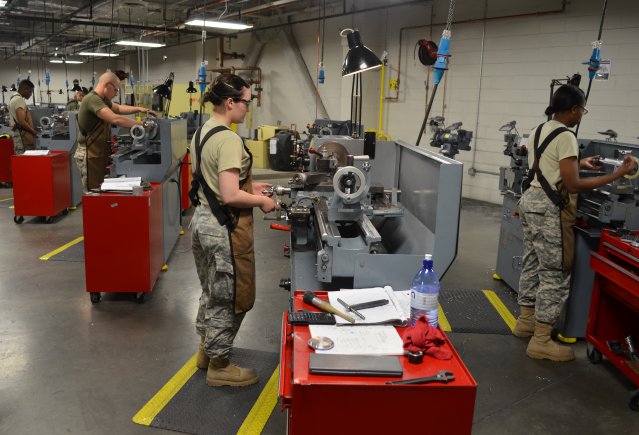
Training would consist of 10 weeks of Basic Combat Training, it is not easy. It is tough, it is hard, it is exhilarating, and it is fun but still physically hard. After basic training he would transfer to the Army Ordnance School at Fort Lee, Virginia (Petersburg), for training as a machinist/welder. He would get to skip the welder part. That is Army MOS (Military Occupational Specialty) 91E Allied Trades Specialist. The normal AIT (Advanced Individual Training) for that MOS is 19 weeks, 2 days long, but this person would skip the welding part of 8 weeks. What he would study is Machine Shop Fundamentals and Safety, Precision Measuring Tools, Metal Identification, Precision Layout, Operate Hand and Machine drills, Hand Threading Operations, Thread repair, Countersinking, Counter boring, and Reaming, Riveting Operations, Lathe Operations and Vertical Milling Machine Operations. They use Computer numerical control (CNC) machining, which is a machining process in which a computer controls the movements of the lathe or milling machine using a program made up of numerical code called “G Code”. CNC technology allows the machinist to manufacture single or multiple parts with speed and accuracy that is not possible on any manual machine. They use Haas Automation, Inc., toolroom lathes (TL-1’s) and toolroom mills (TM-1’s). These machines are equipped with Haas Intuitive Programming System (IPS), which can create parts programs with very little effort, and allows programs to be uploaded from separate computers. Included are 23 hours of introduction to machining, 52 hours of bench layout operations, 192 hours of lathe operations and 82 hours of milling operations.


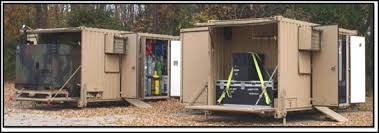
The course ends with three weeks of Army Combat and Tactical Equipment, Titanium Welding, Depleted Uranium, Introduction to Battle Damage Assessment and Repair Operations, TAMMS (The Army Maintenance Management System), ETMs (Electronic Technical Manuals) and PMCS Procedures (Preventive Maintenance Checks and Services) and Department of the Army Forms. He learns to set up and use the Army metal working and machine shop set (MWMSS). The MWMSS consists of two expandable mobile containers. One contains a CNC toolroom lathe (TL-1), a Miller XMT 350 and a Dynasty 200 welder, thermal cutting equipment, air-arc gouging capability, an air compressor, a generator for shop power, an environmental control unit (ECU), and an assortment of hand tools. The other contains a CNC toolroom mill (TM-1), a CNC plasma cutting table, an ECU, and more hand tools. Together they create a field metalworking repair complex. The MWMSS also contains a laptop computer with CAD/CAM software (Computer Aided Design/Computer Aided Manufacturing), which allows the Allied Trades Specialist to create a part design or download it from a manufacturer, upload it to the CNC machine and manufacture the part, in the field.


Already being a certified welder, before leaving 91E AIT this person would be tested and receive NIMS (National Institute for Metalworking Skills) certifications in CNC Milling and CNC Turning: Operations I, and Programming, Setup & Operations I, Drill Press I and II, Job Planning, Benchwork & Layout I, Measurement, Materials & Safety I, Milling I, Turning Between Centers I, and Turning II.
Army 91E’s describe themselves as jacks of all trades. What is similar to civilian shops is – they fix metal things that are broken, and they make metal things. Can you fix this? Can you make a tool to do that. Can you make a rack that will hold these but will also turn around, stand up and open on its own? Sometimes it takes some noggin work. A Chief Warrant Officer Allied Trades Technician, with 19 years in the Army said; “It is difficult for me to state specifically what Army welders do, because we do a little bit of everything. I say we solve problems. I have repaired radiators, weldments on tracked vehicle hulls, and a plethora of other random items. Anyone with a little bit of skill can replace a transmission, yet only someone with great attention to detail can drill, tap, and insert 17 holes stripped in an aluminum transmission housing, all while it is attached to the vehicle and the person is lying in the sand in the desert of California. I have repaired and fabricated more parts and equipment than I can remember. Each time, I learned something new and gained invaluable experience. I’m still sometimes surprised by the metal components Soldiers manage to break or the special tools I am frequently asked to fabricate.”
After training and assignment to a permanent unit, this person could get family housing on post, which I would highly recommend. He would lose the BAH, which would go to pay for the house and utilities, but gain BAS (Basic Allowance for Subsistence) (meals) of $369.39 per month. After 60 days in the Army soldiers may contribute up to 3 percent of their base pay to the Army Thrift Savings Plan (TSP), which is matched by the government. The TSP can be rolled into an IRA after service. So take away the BAH and TSP and add the BAS leaves a take home pay of $1,085.56 per pay period or $2,171.12 per month. The monthly times 12 divided by 52 equals just over $500.00 per week take home pay. Some may look at that and say “That’s not much”, but he has no rent, no utilities, no trash pickup, and no health insurance cost. Family health is monitored by a Family Practitioner at the on post hospital. They live in a nice well maintained house in a nice secure neighborhood (on post) and someone else even mows the lawn.
Where would that person be assigned? About anywhere, but primarily to the posts & locations that have combat units. Every combat battalion has a forward support company which includes 91E’s. My recommendation is always go airborne, jump out of airplanes, which 91E’s probably do every three months. That would probably mean the 82nd Airborne Division at Fort Bragg, North Carolina. The best unit and the largest and best post.
Army life is not harder than civilian life, it is different. You get up in the morning, go into your unit at around 6:00 – 6:30, and do PT (physical training), exercises and run or gym or athletics for a good hour – it’s good for you. Go back home, clean up, eat breakfast, put on a uniform and go to work at 8:30 to 9:00. If you’re a 91E, you go to your shop and work on whatever is the current project. If your unit is going to the field for just a couple days you may take a Shop Equipment Welding (SEW) trailer, which is just a trailer with a portable welder, torches, and other portable tools. If it is a long big exercise you may take an MWMSS. If you’re in garrison, and live on post, you may run home for lunch, or eat in a Dining Facility or a snack bar. You’re off at 5:00 PM normally. You are off weekends. In many ways it is an easier life than civilian life. You don’t worry about your job or making a living, you don’t worry about health and dental care, and if you live on post you don’t worry about the druggies next door or down the street – there are not any.

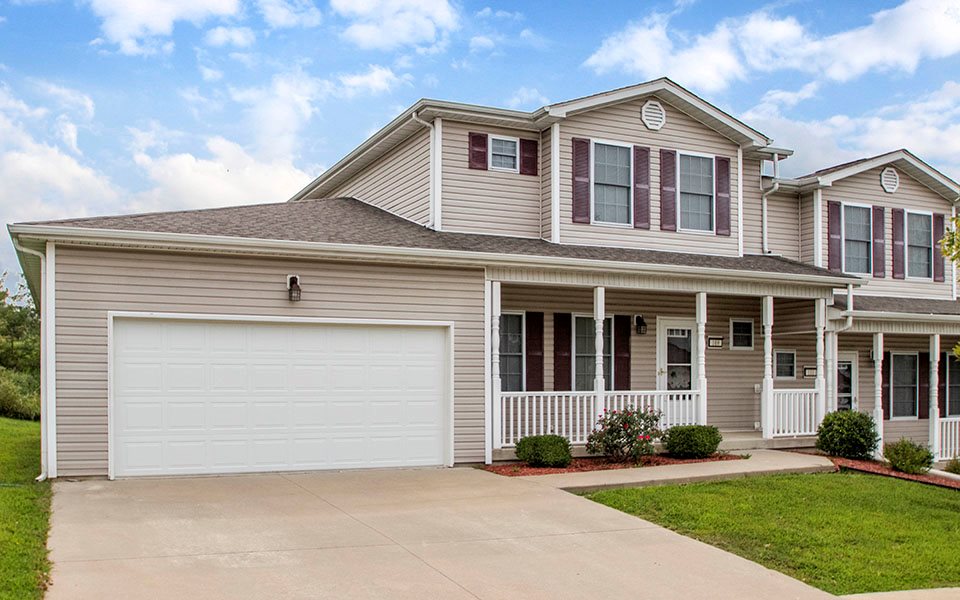
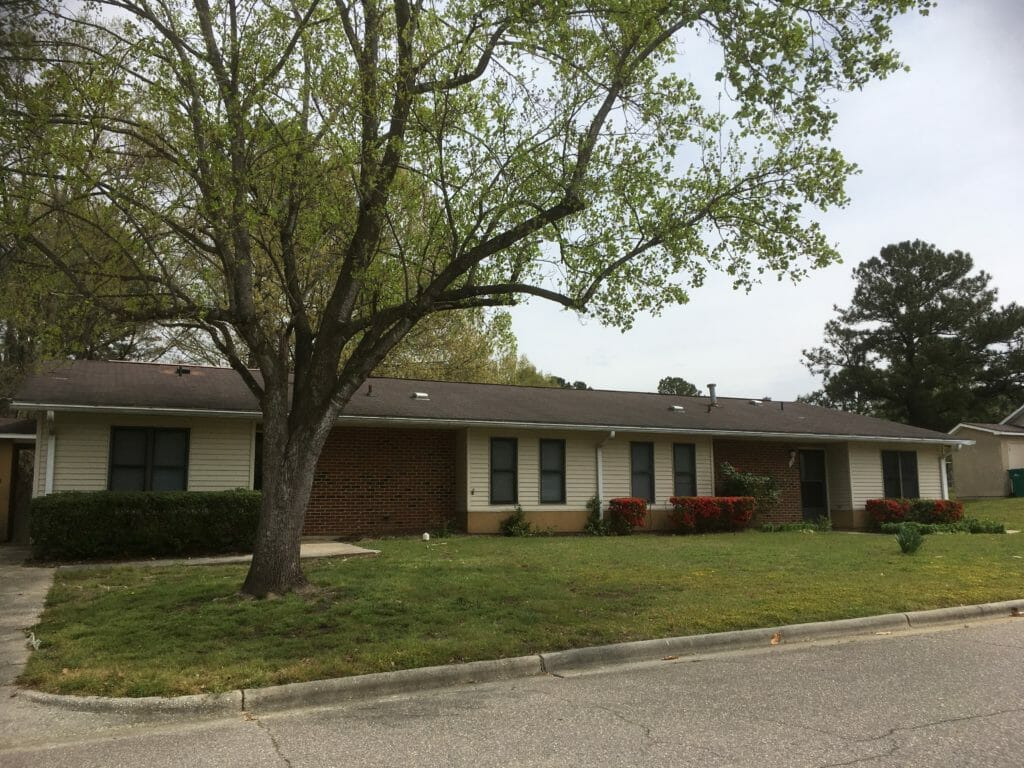
Eagle Point family housing on Fort Leonard Wood
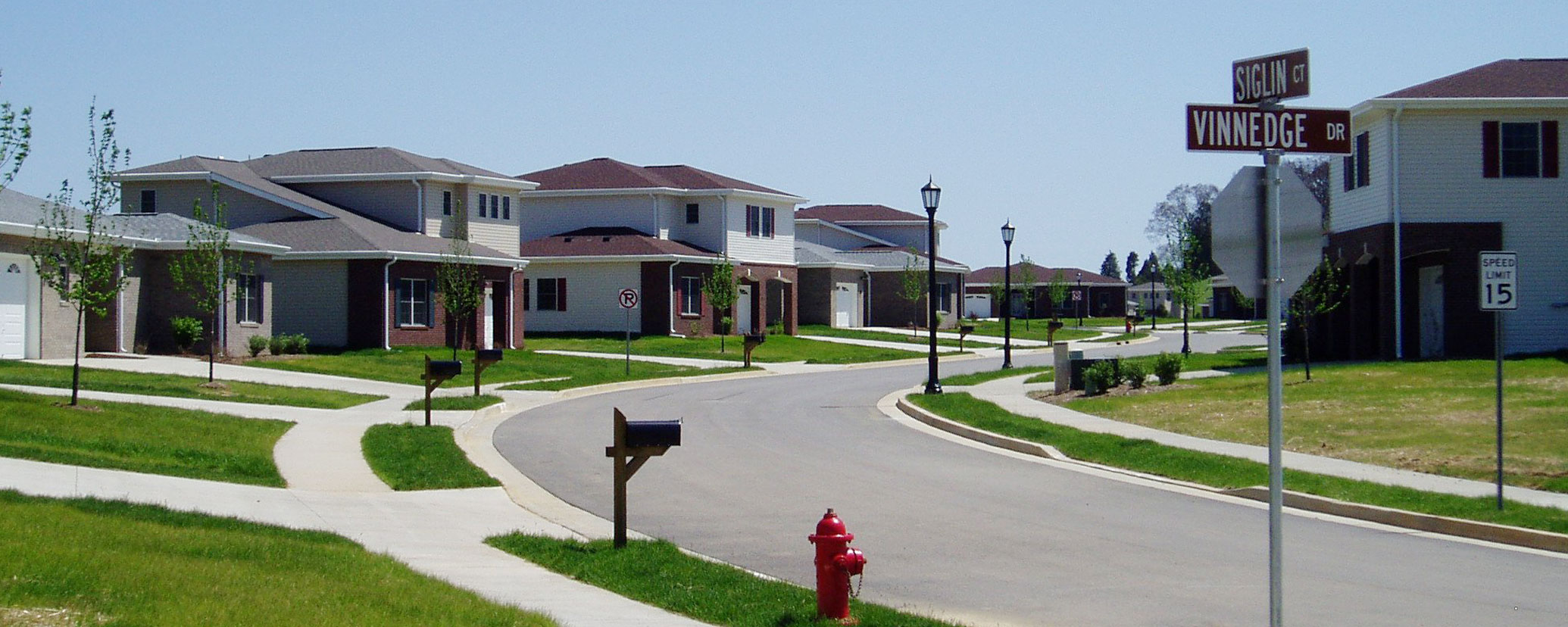
Fort Knox family housing

Family duplex on Fort Bragg

CYBER WAR

This was originally published in The Belle Banner, Belle Missouri May 23rd 2018. If you would like to see the current articles as they are published, you may subscribe to The Belle Banner by calling 573-859-3328, or email tcnpub3@gmail.com, or mail to The Belle Banner, PO Box 711, Belle, MO 65013. Subscription rates are; Maries, Osage, and Gasconade County = $23.55 per year, elsewhere in Missouri = $26.77, outside Missouri = $27.00, and foreign countries = $40.00.
Computer technology is the most rapidly changing and advancing endeavor in which humans are engaged today. Put that rapidly changing system against the military’s agonizingly slow procurement process and you find a big problem. Systems are outdated before the military can get them in their system.
When the current Chief of Staff of the Army, General Mark Milley, was appointed in August 2015, the Army had been trying to decide on a new pistol for almost a decade. Prototypes had been being tested for two years at a cost of 17 million dollars. General Milley was appalled, he said; “We’re not figuring out the next lunar landing. This is a pistol. Two years to test? At $17 million?” Milley said to an audience at a Washington, D.C., think tank on March 10th 2016. “You give me $17 million on a credit card, and I’ll call Cabela’s tonight, and I’ll outfit every soldier, sailor, airman and Marine with a pistol for $17 million. And I’ll get a discount on a bulk buy.”
First the need must be established, which requires a study. What is our current stuff not doing that new stuff will? Then there is a funding request, which usually requires action by congress. Once the funding is approved, then bids with prototypes are requested from several manufacturers. Then the thing or the stuff is evaluated, tested. After a final decision is made, then there is manufacturing/production time to get it to the troops. That whole process usually takes years.
In 2002, the Army created the “Rapid Equipping Force”. It was created because of requirements in Iraq and Afghanistan. It is basically an organization that can bypass the normal procurement process and get equipment and/or material, “off the shelf” if necessary, into the hands of troops immediately. It works.
With commercial business computer hacking and foreign governments also getting into devious computer warfare, military leadership realized that the military had to get up to speed fast, in the arena of computer knowledge and ability. Around 2010 all the services started the process of creating “Cyber Commands”. The Army created the Army Cyber Command at Fort Gordon, Georgia (Augusta), and started soliciting soldiers from within the Army, who were already computer experts. The Secretary of the Army, at that time, discussed trying to recruit civilian computer people into the Army up to the rank of Colonel. Congress never considered it, because they found that most computer people in upper level management, with around 20 years of experience, are paid far more than Army colonels. Then it started developing training to create its own computer guru’s. Initially the training was only for current soldiers who had been accepted into the training. Now people can enlist to be a computer hacker.
As an update to this story congress finally did pass a defense bill which allows the services to take people into the military up to the rank of colonel. The services haven’t yet turned that law into regulations.
In August 2016 the Army created a “Rapid Capabilities Office” specifically to get the latest technology in cyber and electronic warfare to the Army fast. It has partnered with industry to keep the Army on the cutting edge of cyber warfare.
This month, May 2018, the United States Cyber Command was designated as a standalone, four star, unified command. General Paul Nakasone was promoted to four stars and moved from the Army Cyber Command to Command the US Cyber Command, under which supervises the cyber commands of all services.
Army MOS (Military Occupational Specialty) 17C Cyber Operations Specialist. This Army job requires a Top Secret security clearance, which takes a little time to process because the persons’ friends, neighbors, co-workers, classmates, teachers and preacher will be interviewed. The ASVAB requirements are high, scoring 112 in ST (skilled technical), which is comprised of the following tests; word knowledge, paragraph comprehension (English), general science, (earth science, biology, chemistry, physics), mechanical comprehension, and mathematics knowledge (algebra), and 110 in GT (General technical) which consists of word knowledge, paragraph comprehension, and arithmetic reasoning. However, if a person really wants to get into this they need to score in the high 120’s or 130’s in both of those areas.
After ten weeks of basic training, the prospective 17C goes to a total of 48 weeks of training. The first phase is the 24 week Joint Cyber Analysis Course, taught by the Navy, at Corry Station, Florida. The subjects taught there are; Discrete Structures, Programming Fundamentals, Computer Organization and Architecture, Operating Systems, Networking Concepts & Protocols, Windows, Unix, Programming, Enterprise Level Networking, Protocol Analysis, Wireless Technologies, Target Research/SIGINT (Signal Intelligence) Analysis, Active Exploitation, Computer Network Defense, and Forensics Methodologies & Malware Analysis. That is the same as an Associate’s Degree in Computer Science crammed into six months. Upon completion of phase one, the soldier moves to Fort Gordon, Georgia for 24 weeks of phase two. The subjects taught there are not published.
For the person who doesn’t want to be chained to a computer screen, but likes to get out in the field occasionally, there is another job which doesn’t require as long a training period, and gets out into the field. Army MOS 29E is currently being changed to 17E and brought under the Cyber Command, is Electronic Warfare Specialist. How would you like to be able stop a tank dead still, without firing a shot, or deactivate an IED (Improvised Explosive Device) without getting close to it, or cause enemy radar to see a clear sky where your aircraft are flying? One night in 2007 Israel bombed a nuclear site inside Syria. Prior to and during the operation (Orchard) their electronic warfare people took control of Syrian radar and showed the Syrians a clear sky.
When the 82nd Airborne Division wants to insure that it is well trained on a piece of equipment or a procedure, it has a competition. Tests are designed and all the units in the division of that specialty compete to see who is the best, and who will have bragging rights for a year, as being the best at what they do. This month is the first annual 82nd Airborne Division Electronic Warfare Competition. Each Brigade Combat Team in the Division has a CEMA Cell (Cyber Electromagnetic Activities). Their equipment is carried on their back, about the size of a full rucksack, with antennas sticking out. They can detect and jam enemy signals, defeat unmanned aerial systems and disable IED’s. They can pinpoint troops and vehicles both moving and stopped in rough terrain (Afghanistan).
The current Army MOS for Electronic Warfare Specialist is 29E. That training nine weeks at Fort Sill, Oklahoma, after basic training. The ASVAB requirements are 100 in SC (Surveillance and Communications) which consists of Verbal Expression (VE), Arithmetic Reasoning (AR), Auto & Shop (AS), and Mechanical Comprehension (MC), and 100 in ST Skilled Technical which consists of Word Knowledge, Paragraph Comprehension, General Science, Mechanical Comprehension and Mathematics Knowledge. This job is basically that of an equipment operator, albeit fairly high tech, whereas the Cyber Operations Specialists operates in the shadow world of recognizing cyber signatures, tracking them, and causing them to do what the Cyber Operations Specialists wants them to do, not what the original operator intended for them.
In the computer science/engineering world experience is the biggest asset. Where a person went to school, to get their degree, may help them get their first job, but after that it is what they know and what they can do that lands the next higher paying job. A soldier leaving the Army after a few years as a 17C, who has hopefully completed a bachelor’s degree, will be looked at by prospective employers as a very experienced IT person, especially in the area of cyber defense.,

SUICIDE

This was originally published in The Belle Banner, Belle Missouri March 13th 2019.
This was just published a few weeks ago, but I want to get it online now because of the seriousness of the subject.

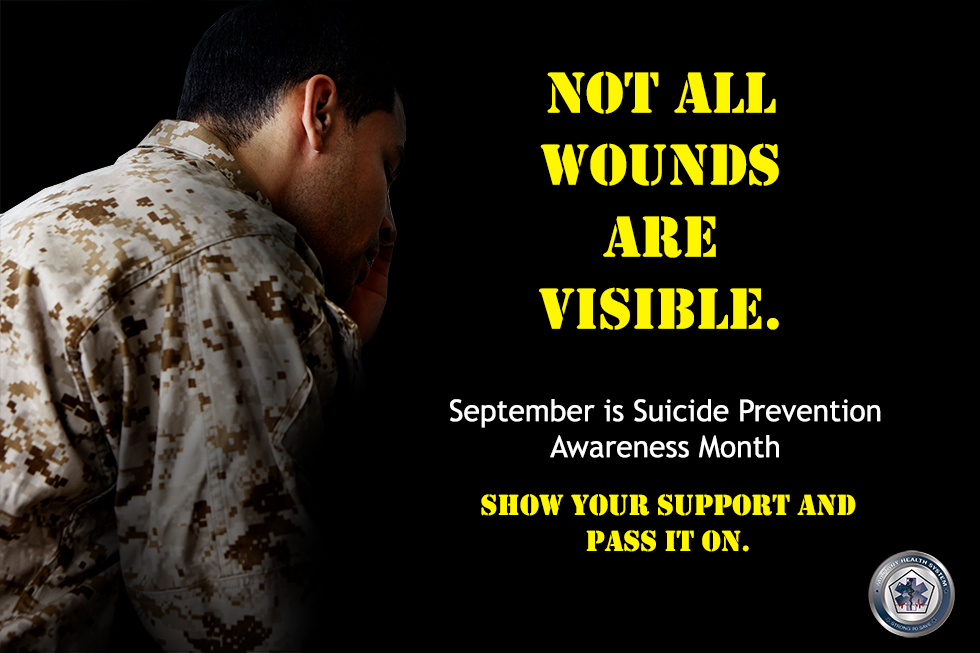
For the past month one of the big news items has been that military suicide is at an all-time high. The figures released by the Department of Defense of active duty suicides in 2018 are; Marines – 57, Navy – 68, Air Force – 58, and Army – 138. Marines, sailors, and airmen who take their own lives are often young people who have never deployed. The causes, which have been identified, are what you might expect, relationships, marriage problems, and financial problems, but in the Army the overwhelming majority come from special operations, and in particular Special Forces – the Green Berets. These are older men who have been deployed over and over and over for the past 15 years. Suicides within that group tripled in 2018, and after they leave the Army they are still a large percentage of veteran suicides.
If you overwork anything, it will wear out. That has been the message Special Operations Command (SOCOM) leaders have been telling congress for the past several years. Most of the work of Special Forces is classified. The shadow warriors. The silent professionals. There are five active Special Forces Groups with a total of less than 5,000 Green Berets, and there are two National Guard Groups. Two years ago the Commander of the US Special Operations Command testified before the House Armed Services Committee that Special Forces were deployed to 138 countries, or about 70 percent of the world.
When we were first married in 1966, Special Forces was a big attraction to us grunts in the 82nd Airborne Division at Fort Bragg, North Carolina. They were getting promoted much faster than we were. My wife Betty said “No way”. Our SF neighbors would go on a three month deployment, come home for 30 days then go on a six month deployment to Vietnam, and then repeat it over and over. The rumor was that the SF divorce rate was 70 percent, I don’t doubt it. We had been married six months when I went to Vietnam the first time. Guess where I got assigned – the 5th Special Forces Group.
In Special Forces an Advise and Assist mission means a 12 man A Detachment (A Team) is sent into a backward undeveloped country that is at war with its neighbor. The team’s mission is to train an army, with little outside support, and take it into combat. They also go into modern developed nations to train them in unconventional warfare (guerilla fighting). They go on medical assistance missions to undeveloped nations. When the United States of America invaded Afghanistan it was with one 12 man Special Forces A-Team. Twelve Strong. In Iraq, Afghanistan, Syria, Somalia, and several others Green Berets have been engaged in combat over and over, with most of it classified, so they can’t talk about it.
During my time in the Army, Sergeants didn’t show emotion, it was a sign of weakness. The only place you could release those inner feelings was at home. That is apparently still the case. There are stories from wives of Green Berets who committed suicide, about the change the wife saw in her husband after several deployments. Complete personality changes. Even after urging from their wife the soldiers would not seek help, because they would lose their security clearance and possibly get kicked out of SF or of the Army. I knew a couple soldiers who had nervous breakdowns. One Personnel Sergeant was able to recover and stay in the Army. The other committed suicide.
Everything the Delta Force does is classified. If you want to know more about Delta, read “Inside Delta Force” by Eric Haney. He and I were on orders to the first Delta assessment class, I didn’t go, he did and made it, and spent several years as a Delta Operator. He then wrote the book and was technical advisor on the TV show “The Unit”. The Command Sergeant Major (CSM) of the US Special Operations Command, Chris Farris, came up through the ranks of special operations, having spent 18 years as a Delta Operator. After many repeated deployments, CSM Farris and his wife Lisa, saw their marriage coming apart. They vowed to fix it, and they did. For the past few years they have together visited special operations groups everywhere, held town hall meetings, and appeared on television, urging soldiers to confront their problems and get help, if necessary. CSM Farris said that he didn’t think that he was suffering from traumatic stress, but an examination identified three spots on his brain that showed traumatic brain injury. He could only remember one incident of being “blown up”, but thinking back he recalled repeated training on breeching. Breeching is basically blowing open a door or an obstacle with a big explosion, and immediately going through it, so you have to be as close as possible when you blow it open.
Career soldiers have an attachment to and a love for the Army that is hard to explain to people who haven’t been there. The more elite the unit, the stronger the attachment. I pulled strings to get my last job in the Army at home, in the ROTC Department of MS&T (then University of Missouri-Rolla). I knew in the back of my mind that it would be my last assignment. I was home, helping Dad and Mom on the farm, my kids going to school where I and my Dad went to school, reconnecting with old friends and relatives, but that didn’t change the devastating trauma I felt taking off the uniform. I don’t regret retiring then, because I got to spend the last 14 years of my Dad’s life with him, and that was more important, but leaving the Army was traumatic.
During my first tour in Vietnam, with Special Forces, I contracted hepatitis from eating some really bad stuff. Our medic said; “You got yellow jaundice man, you got to go to the hospital.” Two months later, when I was released from the hospital in Japan, I was told that since I had only been in country nine months and two weeks, I had to go back, because anything less than 10 months was considered an incomplete tour. My enlistment was about up, so I got out of the Army. Two years later, after selling new and used cars in Fayetteville and Charlotte, North Carolina, I couldn’t stand it anymore so I went back to the Army. Leaving the Army was like leaving a family that had cared for me for over twenty years. I was then a civilian, making a living just like everyone else, something that doesn’t concern soldiers.
A few years ago I attended a Veterans Day assembly at my grandson’s school in Ballwin. A speaker there was a man about 40 years old. He talked about his high school friend who was a star athlete, set athletic records at their school, and was smart and good at everything. His friend had scholarships, but wanted to go into the Army. His friend spent several years in the Army. He said that he saw his friend one day, wearing an old army field jacket, sitting on a bench at the Barnes Hospital complex. His friend slept on benches or under bushes. He said that he ask why, “You have family here.” His friend said yes but they just don’t understand, they just don’t understand.
It is an honor to serve in the Armed Forces of this great country. Most people who serve, do their job and their time, get out and go on with life. Over 17 percent of those who enlist, stay for a career. It is a protected and secure life, leaving it can be traumatic. I think problems veterans have will surface shortly after their leaving the service, so it you know a recent veteran who appears to be struggling, offer to help or encourage them to get help.
On March 6th President Trump signed an Executive Order creating a task force to study and attempt to reduce veteran suicide. Prayers with that task force. The active army is already taking action. Senior leaders like CSM Farris and a few generals are starting to go public with their battles with service connected stress, in an attempt to get the soldiers who are suffering to seek help. The inner culture of special operations does not encourage soldiers to admit that they are suffering.
The Army is having trouble increasing the number of soldiers, therefore having trouble increasing the size of special operations. Perhaps the United States needs to reduce the number of missions around the world.

BECOME AN ARMY AUTOMOTIVE TECHNICIAN

This was originally published in The Belle Banner, Belle Missouri, October 31st 2018. If you would like to see the current articles as they are published, you may subscribe to The Belle Banner by calling 573-859-3328, or email tcnpub3@gmail.com, or mail to The Belle Banner, PO Box 711, Belle, MO 65013. Subscription rates are; Maries, Osage, and Gasconade County = $23.55 per year, elsewhere in Missouri = $26.77, outside Missouri = $27.00, and foreign countries = $40.00.
When I was 16 my friend Doug Rector had an old straight six Chevrolet with a bad motor. Doug got another motor from Vic Butlers’ junk yard and got the motor to my house. One evening after school we threw a chain over the front door beam of Dads’ Quonset shed, pulled the old motor, and installed the good one and Doug drove away before morning. There wasn’t anything we couldn’t do to or with a car, and we weren’t exceptions. Some boys built hot rods, and some built customs. The popular term was “shad tree mechanic”, because often the work was done under a big tree with a limb large enough to support a car engine. Often the knowledge was gained by taking it apart to see how it worked. We learned how to adjust valves and set points by how the engine sounded, but times have changed. Aside from a few diesel pickup addicts’ young people now are not as interested in “building their own” ride. Now a Certified Automotive Technician must not only know the basic functions of engines, transmissions and differentials but must also understand how the sometimes hundreds of sensors and microchips, in a vehicle, function in relation to each other into the main computer of the vehicle.
I enlisted in the Army 15 years after the end of World War II, and at that time the Army seemed to have forgotten the value of mechanics, and Vietnam didn’t change things much. Mechanics were guys in the motor pool who kept the vehicle running. It was often a mundane job with a lot of preventive maintenance (busy work) and not much excitement. The wars in Iraq and Afghanistan changed things. The vehicles were more complicated and they were essential, they had to be kept running.
In November 2007 the Army News Service published an article from Forward Operating Base Sharana, Afghanistan. The mechanics had been working since 4:00 AM, just got to sleep and at 10:00 PM were awakened to go back to their shop. A unit had brought in a Hummv with the front drive not working. In the rough Afghanistan terrain four wheel drive is essential, and this vehicle had to be back on the road by morning. The front differential had to be replaced, a good four to five hour job. Using parts from other damaged vehicles, it was ready to roll before daylight. Private First Class Carson Beaver said; “This is a very important job, keeping units coming through here on their feet. When they come to us needing something fixed, they know were reliable and they’ll be able to continue on their mission.”
The Army has 14 different mechanic MOS’s (Military Occupational Specialties). Tank Mechanic, Stryker Vehicle Mechanic, Bradley Vehicle Mechanic, and Artillery Mechanic are a few, but to become an automobile mechanic the MOS is 91B Wheeled Vehicle Mechanic.
A few years ago the Army started trying to bring all training and jobs that have similar civilian jobs up to the civilian standard and help the soldier get civilian credentials for that occupation. Ten years ago the comments from Army mechanics were something like; The only thing you learn in AIT (Advanced Individual Training) is how to read Technical Manuals, or You don’t learn anything in AIT, you learn it all at your unit. It was around that time the US Army Ordnance Corps began discussing it’s training of Army Mechanics. Wheeled Vehicle Mechanics were being trained in four different posts scattered around the country, and military vehicles and civilian automobiles took a giant leap forward in technology. A new training facility and barracks was constructed and all training consolidated at the Army Ordnance Center at Fort Lee, Virginia (Petersburg). The curriculum for the 91B course was completely changed, and during the current 13 week AIT there is classroom/computer work plus plenty of “lab” work in a giant, spotless maintenance facility where the students work on everything from big diesels to small gasoline engines, plus all learn and get hands on work on all vehicle systems.
To sit for the test to become an ASE (National Institute for Automotive Service Excellence) Certified Automotive Technician, two years of tech school plus two years of experience is required. An Army 91B who has completed the 13 week AIT and has two years performance as a 91B may sit for the test. However, comments from former soldiers indicate that a lot of study is required to pass the test.
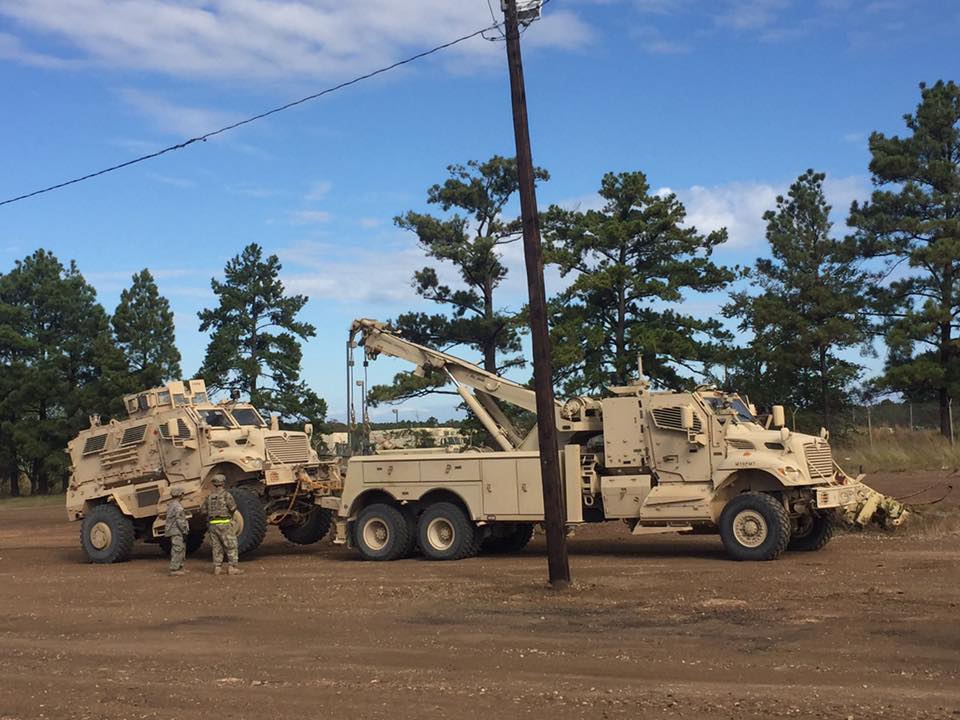
Comments from 91B’s in the Army now are generally positive. They get to turn a lot of wrenches and are generally satisfied with their jobs, although there are sometimes long hours, especially on deployments. The guys who take wreckers and recovery vehicles out and pick up broken or damaged vehicles have an additional skill identified (ASI) on their MOS of H8, which is an extra two week course. All who commented highly recommended that any 91B take that course whenever they can. Most Army units now have “Mechanic of the Quarter” competitions, and some have unit against unit mechanic competitions.
Every Army Brigade Combat Team has a Brigade Support Battalion (BSB). One company in that battalion is a Maintenance Company, there is also a Supply Company and a Medical Company, and also in that battalion are Forward Support Companies, attached to each combat battalion, which have a large Maintenance Platoon and a Recovery Section. I always recommend that anyone considering the Army get the airborne option in their contract, if possible. The more elite the unit, the higher the morale in that unit. The 82nd Airborne Division has three Brigade Combat Teams, each has a Brigade Support Battalion. One in particular has captured my fascination.
The 407th BSB is part of the 2nd Brigade Combat Team. The 2nd Brigade is the Falcon Brigade, built around the 325th Infantry, whose mascot is the Falcon. The 1st Battalion 325th is the Red Falcons, the 2nd the White Falcons, and the 1st Squadron 73rd Cavalry the Blue Falcons. But the 407th BSB, whose motto is “Supply is Strength”, call themselves “The Golden Griffins”. A “Griffin” is a mythical character with the body of a Lion and the head and wings of an Eagle. The Golden Griffins take on their roll of support with a gusto not seen is most support units. Company B is the Maintenance Company, the mechanics, they call themselves the “Weasels”.

                                           407th Brigade Support Battalion

                                          B Company 407th BSB

The men and women of the Golden Griffins and the Weasels are paratroopers, they jump out of airplanes at least once every three months, usually more often. Weekdays, if not in the field or deployed, they start their day at 6:30 AM with an hour of good airborne physical training (PT) and a good long run. They take a PT test for record at least once a year, they also fire their rifles for qualification and go through the gas chamber annually. But primarily the Weasels are mechanics, who are very proud of keeping everything rolling, and they are family.

                                           Weasel Recovery Operation

                                         A Weasel re-enlisting on top of his recovery vehicle

Weasel family gathering

Weasels at work


NO GAIN WITHOUT PAIN

This was originally published in The Belle Banner, Belle Missouri May 9th 2018.
Throughout the Bible, Jesus’ message was, you don’t get until you give. Benjamin Franklin wrote “there are no gains without pains. If you want more, you have to do more.
I’m sure there are at least a couple people graduating from high school whose plan for the future is simply to get the best job they can find, and there is nothing wrong with that. There are several local business owners who did just that.
What do you want? Decent money, a nice place to live, afford a nice car, money left over for fun, and be able to go to college? Or, do you want to get married and have all those things. And what about the job, do you want a job that you can enjoy, a job that is respected and carries responsibility?
I recently wrote about who the people are who are enlisting in the Army. By far the largest percentage are those who already know the Army. Either their parents were career Army or they grew up next door to the Army, but if you haven’t been around the military, it is an unknown, and many people fear the unknown. Plus there is pain.
First there is the enlistment process, you have to be medically, mentally, morally, and physically qualified to enlist. There are the ASVAB tests. If you want high tech job such as a highly classified satellite communications specialist or you want to learn to be a computer hacker, then you have to score very high on the ASVAB. Study for it. You need to be in very good physical condition before basic training. Start running and exercise, pushups, situps, and pullups. What job? All jobs are open to women. There are currently a few women in the infantry. What kind of job do you want? Be honest with yourself. Most women I know don’t want an actual combat job, some do. For years, if an enlistee couldn’t do anything else, they made him or her a cook, which was considered the bottom of the list of Army jobs. Not true anymore, now a cook is a respected culinary specialist.
Then there is training. Reception processing is the pits. It is stuff that has to be completed. The first day at basic training is hell, it is meant to be, and basic training is getting tougher. The purpose of basic training is to convert undisciplined civilians into disciplined soldiers. My advice is to try to master every task quickly, and have fun. Try to see humor. By about the third week, most basic training classes have gelled together and really do start having fun. As of this writing, basic training is 10 weeks, but I expect it to go to 11 or 12 this summer. Advanced Individual Training (AIT) varies from 7 to 8 weeks to over a year for cardiology specialists, or computer hackers. If the job you choose has an airborne option, I highly recommend it. That is jumping out of airplanes. It’s not scary, it’s fun, and the units are the elite of the Army, with the best leaders. The 82nd Airborne Division at Fort Bragg, North Carolina is the most trained, hardest worked and most used division in the Army, and it has the highest morale in the Army.
After training life is different, radically different, you are another soldier. If you are single, you will live in the barracks. Big deal, you have your own room and your car is parked outside. If you are married you can live in family housing on post. There are apartments and individual houses. They are nice houses with maintenance and utilities paid for with your Basic Allowance for Housing (BAH), which for a Private at Fort Leonard Wood is $876 per month, at Fort Bragg, North Carolina it is $1,134, or you can take the money and live off post. For a young newly married couple I recommend living on post. Everything you need, gas stations, Post Exchanges (stores), are available, plus every post has at least one giant commissary, which is like a grocery store super center. Every post has multiple gyms, chapels, athletic facilities, and recreation equipment available. Medical care is free for the soldier and his or her family. The cost for delivering a baby in an Army hospital is less than $50. Dental care is free for the soldier. Dental insurance which covers about everything for spouse and children is $11 per month for the wife or $29 for an entire family. A married PFC E3 (Private First Class), who has been in the Army about a year, living in family housing on post and claiming 2 dependents on the W4 form, will have deposited in his or her bank account about $1,000 on the 1st of the month and again on the 15th of the month. That equals about $460 per week take home pay or a wage of about $13.50 per hour, after your house and insurance is paid.
Combat units have field duty, training posts like Fort Leonard Wood don’t usually. The Army works five days a week. In the 24 hour a day places, like hospitals or military police, the individual soldiers still only work five days a week. A normal day starts with PT (physical training), then an eight hour day and you’re off. Weekends are off. Federal holidays that are on Monday means a three day weekend off. Every soldier gets 30 days leave (paid vacation) per year.
Don’t want to miss out on college? Every post has an education center where several college and universities conduct evening and on-line classes, and the Army pays for 16 semester hours per year. Advanced education is pushed in the Army, every semester hour is worth one promotion point, up to 75 points in an 800 point system for promotion to Sergeant and 100 points for promotion to Staff Sergeant.
There are over 150 different jobs in the Army. Some require great physical effort, some do not, some require intense academic study to learn and maintain proficiency, some do not. Many are skills that transition directly to a civilian job, some are not. The military is very selective about who it admits into the service, but people are people, and what may be considered a great job by some, may be the pits for someone else. I was once in charge of a section in the division personnel shop in the 82nd Airborne Division. There was a PFC in the office who wasn’t happy with his job. He wasn’t a goof off, he did his work, but he would rather have been somewhere else. One day I asked him what he would like to do, if he could have any job in the Army. He lit up with a gleam in his eyes and said; “Drive a tank!” I have no doubt that there were probably tank drivers who, after spending hours in the motor pool scrubbing and maintaining their tank would have traded places with him in a minute. If you don’t know the Army, it’s hard to know if you’re picking a job that you will enjoy, so do some research. Try to find comments online from people in different jobs. Talk to people who have been in the Army. Talk to the recruiters. The Army recruiters in Rolla, Missouri are a very good crew. Sergeant First Class Joel Watts, who is in charge of that office, has been extended on recruiting duty at least once, maybe twice, which means he is doing a good job, which also means they will tell you the truth. Also try to find and talk to people who have retired from the Army. Whether or not they have been in a job that interests you, over a period of 20 years they were probably around it at some time. I will be happy to talk Army with anyone at any time.
Aside from the job a soldier has, life in the Army could be called a “protected life”. Soldiers don’t worry about making a living and keeping their job, they don’t worry about getting sick and missing work, and they don’t worry about health insurance. They concentrate on learning their job better and doing it better, and doing the things they need to do to get promoted to the next rank, like accumulating college hours. Currently about 45 percent of the people who enlist in the Army will re-enlist at least once, and 17 percent of those who enlist will spend at least 20 years in the Army and retire.

This is a battalion in the 173rd Airborne Brigade at Vicenza, Italy having a family day.