Category Archives: Life in the Army

US ARMY ARMOR – BE A TANKER

This was originally published in The Belle Banner, Belle Missouri August 15th 2018.
When I finished basic training, with the 6th Armored Cavalry Regiment, at Fort Knox, Kentucky, the leadership naturally tried to interest us in Armor. There was an M-60 tank, which was fairly new then, on display. We were invited to climb on it and get in to check it over. I took one look down into that tank and decided I would rather walk.
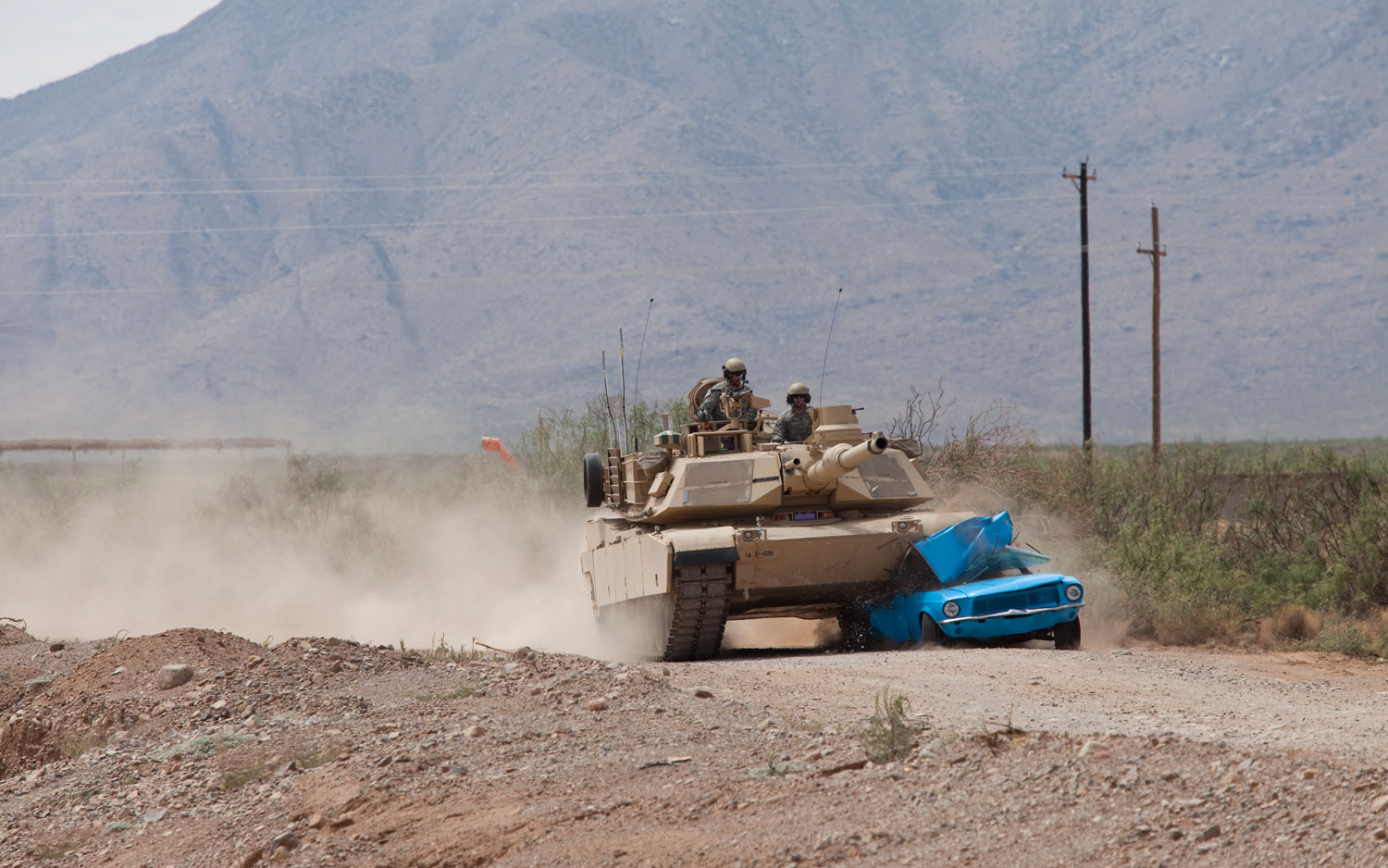
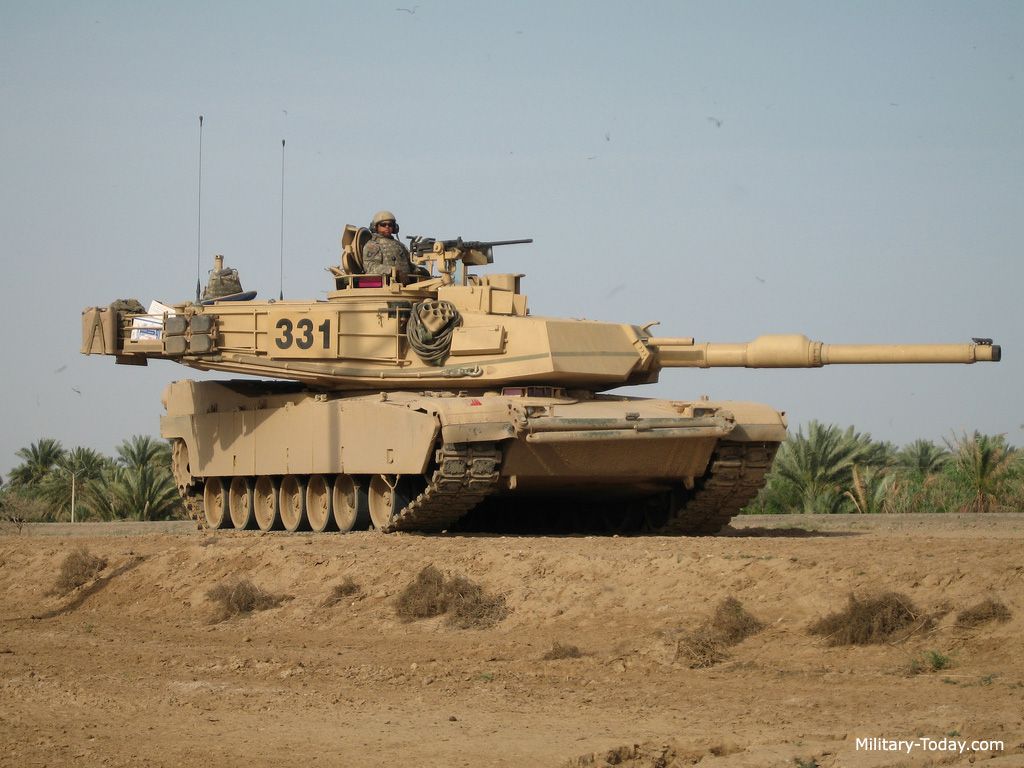
If you want to be in the Army in combat arms that takes it to the enemy, but you don’t want to walk, that pretty well leaves you with Armor, i.e. tanks. That is the M1A2 Abrams Tank.


The M1A2 Abrams is a 12-foot-wide, 8 foot tall, 32 foot long, 68 ton, 9 million dollar hunk of steel with a protective armament of depleted uranium. It is also the most technologically sophisticated and lethal tank on the planet. An Army Lieutenant Colonel said that it is like a giant computer inside a steel box. From the pin point laser range finder and automatic computerized gun adjustment to guarantee first round hits to the Inter-vehicle information system (IVIS) which links all the tanks on the battlefield together so each Tank Commander can see where all the other tanks are located and share enemy information while encrypting it from enemy view. It can hit up to six targets a minute up to two and one half miles away. The main gun is 120 mm cannon which fires different types of rounds, including a kinetic-energy anti-tank depleted-uranium, sabot-wrapped penetrator built to totally liquefy heavy armor over vast distances. There are also two 7.62 mm machineguns and a 12.7 mm machinegun mounted. The specifications say it has a top speed of 45 miles per hour. That is because the 1,500 horse power engine that runs so quiet it has been called “whispering death” has governors set for that speed. Sergeants testing it in the 1970’s said it will run twice that fast, and is as nimble footed as a four wheeler. During the Iraq war Abrams tanks were scoring kills of the top Russian tanks at 2,500 meters. The Russian tank guns had a maximum range of 2,000 meters, so they were being hit before the US tanks came within their range. The Abrams has a crew of four. A Tank Commander, a Gunner, a loader, and a driver.
All but the driver work inside the tank turret. The lowest ranking job on a tank crew, the first job, is loader. The loader rides on the left side of the turret, toward the back. His job is to pull rounds from the ammunition compartment and load the 120 mm main gun. The gunner rides on the right side in the front area of the turret. The gunner pinpoints targets using the laser range finder and computerized firing system and fires the main gun. He tells the loader which round to load. When the main gun fires it recoils inside the turret. Inattention during live fire is extremely dangerous. The Tank Commander rides on the right side toward the back of the turret. The Tank Commander is in charge of the tank’s operation, he has several periscopes and a joystick controlled night vision viewer. He can monitor the tank’s various systems and its position on the integrated display. While the gunner is firing, the Tank Commander can be scanning for more targets. He communicates with other Tank Commanders and his leaders, as well as his crew.
The driver sits in the front section of the hull, directly under the main gun. It is a small space so the driver is leaned back in a form-fitting bucket seat. One driver said it is like riding in a recliner, very comfortable. The driver steers with a motorcycle style handlebar and accelerates using a twist grip throttle. Brakes are pedals on the floor like a car. The tank dash board is in front of the driver, called the driver’s integrated display (DID). The drivers has three periscopes called vision blocks, he can also use a night vision sensor at night. The Tank Commander tells the driver where to go and what to do. The Tank Commander is up higher and can see more than the driver.
So, what is life like in an armor unit? I said once that the Air Force’s primary interest is airplanes, the Navy’s is ships and planes, and the Marines and the Army’s primary interest is people. Well, if you’re in an armor unit, the primary interest is that tank. Everything revolves around your tank. If you are not riding in it, you are working on it. In light infantry, like airborne, if you don’t have anything on the training schedule for a particular day (very rare), that day may turn into Squad training or area maintenance, in armor – you go to the motor pool. If your tank is not conducting training it is in the motor pool, which means you are in the motor pool working on your tank. Tanks get very rough treatment, they break. Plus there is preventive maintenance – all the time. Greasing, adjusting, cleaning, painting, filling out forms swearing that you have done all those things. And yes Sergeant and Staff Sergeant Tank Commanders also work on their tanks, but tankers don’t walk and tankers don’t sleep in the rain, and many live for the days they get to live fire. Some call it the Army’s super sniper rifle. One person said; “Tanker’s really have no skills for the outside world, but it is damn fun. I got out for 6 months after serving 4 years and now I am going back in. I miss the crap out of it. 70 tons +50mph + 120mm gun = lots of excitement.”


Army MOS (Military Occupational Specialty) 19K Armor Crewman requires an ASVAB score of 87 in area CO (Combat Operations). Area CO is a composite score of four tests, word knowledge, paragraph comprehension, automotive and shop information and mechanical comprehension. All army jobs are now open to women, and there are a few (only a handful) of women 19K’s. It is a combat job so the physical requirements are tougher than for support jobs. Armor crewmen are trained in OSUT (one station unit training) companies at Fort Benning, Georgia. That is basic combat training and armor crewman training combined in one company. The training is 15 weeks long. The first four days to a week are spent in the reception battalion processing into the Army, medical, dental, administrative and uniforms. The first eight weeks in the company is regular basic combat training. The first week in the OSUT company trainees learn how to stand, turn, salute, march and talk. They also get their rifle that first week and learn to keep it with them. The second is first aid, land navigation and the gas chamber. The third week is hand-to-hand combat, the obstacle course, and the confidence tower (rappelling). Week four is all about the rifle, the M4 carbine. Trainees dissemble, assemble and clean the rifle, they also learn marksmanship techniques, position, sight picture, breathing, and trigger control. Week five is spent on the firing ranges. Qualification range then moving targets and response firing. Week six is more weapons. Familiarization and firing the M2 .50 cal machinegun, the M-240 machinegun, the M-249 squad automatic weapon and the AT-4 anit-tank weapon. Week seven is tactical movement, throwing live hand grenades, and combat in cities. Week eight is a 10 mile road march to a 4 day field training exercise called “the forge”, and convoy live firing from moving vehicles. The week ends with a beret donning ceremony, ending the basic portion of training. Week nine the trainee starts learning about the M1A2 Abrams tank. How to get in and out of the drivers station, where the instruments and controls are located and what they do, and how to react to a fire. Week ten is about the loaders station. How to load and maintain the main gun, how to operate the tanks radios, how to identify different types of ammunition. Trainees have 15 seconds, experienced loaders can load in 2 to 3 seconds. Week eleven is spent driving in tank simulators in all kinds of terrain and conditions. Week twelve is learning night vision devices and driving Hummv’s on and off road. Week thirteen is driving the tank, also how to maintain it and refuel it. Week fourteen is in the field, driving tanks through various terrain conditions, also firing the main gun and the machineguns in day and night. Week fifteen is a 15 kilometer road march back to garrison, a rite of passage ceremony from basic soldier to tanker, awarding of the Armor Branch insignia, then clean up, out-process and graduate.
New Armor Crewmen are assigned where ever the Army needs them, which could be Fort Benning (Columbus) or Fort Stewart (Liberty) Georgia, Fort Hood (Killeen) or Fort Bliss (El Paso) Texas, Fort Riley (Manhattan) Kansas, Fort Carson (Colorado Springs) Colorado, or Korea. During the cold war, Germany was thick with US Armor and Poland has recently offered to pay the United States the cost of permanently stationing a Brigade in Poland. If we do I would suspect that there will be tanks.

WHY AND WHO ENLISTS IN THE ARMY

This was originally published in The Belle Banner, Belle Missouri May 2nd 2018.
This column is an attempt to educate anyone who will read it about different aspects of life in the Army. Much has been written about the disconnect between the military and the general population. Most people around Belle, Missouri, who have not served, know hardly anything about normal everyday life in the military. Some teenagers in high school have an image of the military, that after seeing “Lone Survivor”, that anyone who goes into that is going to die in combat. Some only think of a picture of a drill sergeant with his hat brim in the face of a trainee, as the military. Neither could be further from the truth.
So, who enlists in the military? Some stories are that only the uneducated lower classes enlist. Not true. The Army is currently in a “build up”, and for the first time ever it is not lowering standards. It is increasing enlistment bonuses to entice people to enlist for particular jobs. A high school diploma is required. If a person only has a GED high school completion, they must have 15 semester hours of college to enlist. They must also score high enough on the ASVAB (Armed Services Vocational Aptitude Battery). The ASVAB is the military version of an ACT or an SAT. It consists of 10 tests, general science, arithmetic reasoning, word knowledge, paragraph comprehension, mathematics knowledge, electronics information, automotive and shop information, mechanical comprehension, assembling objects, and verbal expression. The entire test is three hours long, with individual areas lasting between 10 and 40 minutes. There are school districts in some states where a large percentage of students do not score high enough to be accepted into the military.
Next myth. The majority are from poor families. Not true. Fifty percent of enlisted recruits come from families in the top 40 percent of income, 25 percent of those from families in the top 20 percent of income. Only 10 percent come from the bottom 20 percent.
The majority of recruits come from the south and the southwest. True. That’s because those areas are more rural and patriotic and have more poor areas. No, not true. That’s where the military is located. California has the largest military population (184,000) of any state, mostly Navy and Air Force, but it is does not produce the most recruits. California has the largest unemployed veteran and the largest homeless veteran population of any state. California is ranked number 52, as the least desirable state for military retirement. Texas is the second state in military population (164,000). It also has a large retired military population and a large number of enlistees come from Texas. By far, the largest numbers of recruits come from a block of states in the South/Southeast, Virginia, North Carolina, South Carolina, Georgia and Florida. Almost half of our entire military force, almost 500,000 active duty, is concentrated in those five states. So, who enlists in the military? People who know the military.
“Army brat” or “military brat” is not a description of an undisciplined child. It is a term of affection, compassion, endearment, and respect proudly worn by children of active duty military families. When one military brat introduces themselves to another each understands that they may or may not have a “home town”. Home was where the family was located. They were probably a world traveler, having lived in several states and different countries. Our kids toured German castles, including Neuschwanstein, the Disney castle, plus the Leaning Tower of Pisa and Saint Mark’s Square in Venice, Italy, and the German, Austrian, and Italian Alps. They went to school in North Carolina, Germany, Italy, and South Carolina, as well as Belle, Missouri. Army brats have usually attended several schools, giving up friends as they were leaving, and making new ones at their new home. They grew up watching their father put on a uniform every day and go to work. They saw how proud Dad was when they attended his promotion or award ceremonies. They attended his company picnics and battalion family days. They got to know the soldiers in Dad’s platoon or company, as well as the other kids and mothers. They listened to Dad in the evenings talk about his day, about what was going right and what needed work. They saw Dad get up early and go in to work after he had come in after midnight from a long hard field exercise. He didn’t have to go in early, but he had to see that some things got done. If they were in the car with Mom on post at 5:00 PM, the car stopped and all got out and stood attention as Taps played and the flag was being lowered. Army brats grow up learning the Army from the inside out. They grow up feeling the intense pride their parent or parents have in what they are doing, and when they graduate from high school, some go to a military academy, some to college and take ROTC, and many enlist in the service in which their parent had served.
The largest Army post is Fort Bragg, North Carolina, at Fayetteville, one tenth of all the Army is at Fort Bragg. Camp Lejeune Marine Base, at Jacksonville, North Carolina, with its satellite bases is almost as large. The US Army Recruiting Battalion at Raleigh, North Carolina is the number one recruiting battalion in the country. It supervises recruiting companies in Charlotte, Fayetteville, Greenville, Raleigh, Wilmington, and Winston-Salem. The Commander of the Raleigh Recruiting Battalion, Lieutenant Colonel Daniel Mitchell, said that battalion routinely brings in three times the number of recruits into the Army each year as many of its peers. He said that the Fayetteville Company, next to Fort Bragg, often enlists more recruits into the Army than entire battalions in other parts of the country. They enlist because they grew up in or around the Army.
The 82nd Airborne Division selects a non-commissioned Officer (NCO) of the year and a trooper of the year, each year just prior to All American Week, during which the winner is announced. It is a big deal! Over the years those selected have gone on to be very successful in and out of the Army. The competition starts at company and battalion level, with recommendations, competitions and screening boards. Finally, for the handful that are left at division level, usually three to six, there are three days of tough competition. The first thing on the first day is the Army Physical Fitness Test, then zero and qualify with a rifle, display their familiarization with different weapons systems, and a written test. On day two is night-to-day land navigation course and additional hands-on warrior task assessments in infantry tactics, nuclear, biological and chemical protection and decontamination procedures and medical evacuation. The final day is the Division Board, composed of the Brigade Command Sergeants Major and chaired by the Division Command Sergeant Major.
In 2015, Specialist Terri Bluebird beat out all competitors to become the first female 82nd Airborne Division Trooper of the Year. She was a combat medic. She was also an Army brat. Both her parents were in the Army, in the 82nd Airborne Division. Both were jumpmasters. Her mother, who was a cook, was the first Native American female to retire from the Army. Terri was born in Womack Army Hospital, on post, and grew up on Fort Bragg. She said; “I just wanted to be part of what they thought was the best time of their life”. She was promoted to Sergeant shortly after that, and the next year was selected for the Army’s Active Duty Green to Gold program. She will attend college for two years, paid for by the Army, while continuing her full active duty pay and allowances, then upon completing her bachelors’ degree, she will be commissioned a Second Lieutenant and return to active duty.
After serving in Vietnam, Sergeant Major Albert Brunson with his wife Delphine and family retired from the Army, at Fayetteville, North Carolina, where he had spent a large part of his career. The family came together for an interview in 2008. There were Albert and Delphine and their sons Lieutenant Colonel Xavier Brunson, with his wife, Lieutenant Colonel Kristen Brunson, Major LaHavie Brunson and his wife Karyn, Major Tavi Brunson and his wife Captain Miryam Brunson. Lieutenant Colonel Xavier Brunson said the values that his father brought home were the reason for his decision to join the Army. He said that the earliest roots of those values was the love of our family and the love of this great nation. He said; “….we treat this like a profession. This is our family business.”
Military pay is sufficient. You won’t get rich in the military, but if you live within your means it can be a comfortable life. After our first was born, my wife became a stay at home mom and didn’t work for the next 14 years, until I retired from the Army. Along the way we bought two houses, one of them new, and several new cars. Health care is not a concern, medical and dental care are provided for the service member and his or her family. Housing is provided. The family can live in family housing on post or receive a housing allowance and live off post. Every service member gets 30 days leave (paid vacation) each year. Most soldiers get off work at 5:00 PM and go back to work at around 6:30 AM, with weekends off, plus soldiers in combat units that train hard, like the 82nd Airborne Division, get many three and four day weekends. When Monday is a holiday, commanders will try to make Friday a training holiday, which means most everyone is off from Thursday afternoon to Tuesday morning. Education is pushed hard, and the Army pays for 16 semester hours tuition annually for evening or online classes. Moves are paid for by the military, plus the soldier is paid a “dislocation allowance”.
Aside from the particular job a soldier may have, the life might be called a protected life.
So, who is enlisting in the Army? People who already know the Army. That is also why they are enlisting in such large numbers.

GREEN RAMP DISASTER MARCH 23rd 1994

This was originally published in The Belle Banner, Belle Missouri March 21st 2018.
This is a story of pain, terror, death, as well as pride, courage, and compassion. It is also about the magnificent spirit of the men and women who make up America’s military community.
In 1994 the 23rd of March fell on a Wednesday. That was a bright sunny day with very little wind and temperature in the mid 60’s, in North Carolina. A perfect day for parachute jumps. At Fort Bragg, North Carolina the 82nd Airborne Division had paratroopers from the 504th and the 505th Infantry and the 782nd Support Battalion at the area called “Green Ramp”, which is the area on Pope Air Force Base (at that time, now Pope Field) where parachutes are issued and pre-jump rehearsals are conducted. Also there, were troops from the 525th Military Intelligence Brigade, and the 59th Aviation Battalion of XVIII Airborne Corps. This was to be a “Hollywood” jump, no equipment, just a helmet, a parachute and a reserve chute.
The Green Ramp area had some buildings used by the 82nd Jumpmaster School, a jumpers assembly building called the pack shed, some steel CONEX containers, two Air Force buildings, trailers, a snack bar and the Jumpmaster School training area with C-130 and C-141 airplane mockups on one-foot-high concrete platforms where paratroopers rehearse aircraft exits and taller wooden platforms for practicing parachute landing falls. Two C-141 Starlifters were parked on the runway, waiting to load the paratroopers, about 75 feet from the mockups. Some C-130 Hercules were parked further away. F-16 and A-10 Fighter planes were in the air conducting training. There was a total of about 500 paratroopers at Green Ramp in various stages of preparing for a jump. About 1400 (2:00 PM) Capt. James Rich, the 525th MI Brigade’s S 4 (logistics officer) who was the jumpmaster on one aircraft, had just finished rehearsing duties with his jumpmaster/safety team. Cards in hand, he began to practice a briefing he was to give to the paratroopers at 1430. Members of his group were located under the trees near a C-141 mockup. A short distance away paratroopers from the 504th and 505th were listening to a briefing on static line safety, their backs to the runway, many were sitting, most had their helmets off. Second Lieutenant (2LT) Judson “Jay” Nelson, a Platoon Leader in Company D, of the 2nd Battalion 504th was standing at the back of that formation. Some troops already had their parachutes on and were walking back from the pack shed.
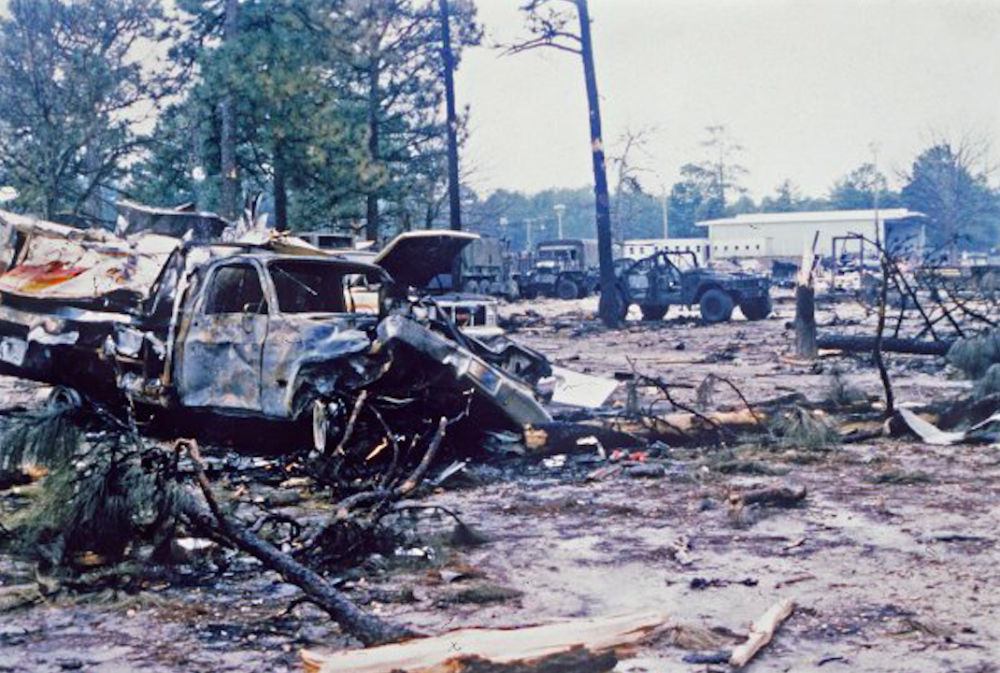
At 1410 (2:10 PM), Capt. Gerald Bebber, the 525th MI Brigade chaplain, remembered that he had left the C-141 mock-up and was about 20 feet from the pack shed when he heard the high pitched screech of a jet fighter airplane at open throttle from beyond the pack shed suddenly give way to a deep reverberating thud and massive explosion. He said; “I recognized the sound from my experience in battle in Desert Storm. As soon as I could think this, a great roaring rush of fire entered my sight above and to the left of the pack shed. It was at tree-top level, slanting down as it gushed into the mockup area at terrific speed…. The flame came though the tops of the trees that stood in a small open area beside the pack shed. In the torrent of flame I saw pieces of wreckage and machinery hurling along. As the torrent rushed in I could hear cries of alarm, curses, and someone yelling “run” from the mock-ups. The fire blast crackled as it blasted in, and at its sides it curled outward as it went forward. I was standing perhaps thirty feet beside the edge of the blast, and could see eddies of the flame curling out toward me. I turned and ran from the flame, to just beyond the right end of the pack shed, where . . . I no longer felt the intense heat, so I stopped. To my left, out on the aircraft ramp, now in my line of sight I could see a parked C-141 engulfed in flames. I turned to face the training area and saw “a scene from hell.” To my right side were two crushed food vendor trucks, one in flames. One of the vendors was on fire, and a soldier standing over him was trying to put out the flames. The row of mock-ups also was in flames, and burning debris and hot metal were everywhere. Within about 25 feet I came across my first victims, two soldiers on fire. While two other rescuers smothered the flames on one soldier, I took off my shirt and knelt down beside the other casualty to extinguish the flames. But the soldier’s uniform top was soaked with fuel, which kept reigniting the fire. Finally, I shoveled sand and gravel from the path that ran along the mock-ups onto the soldier’s back and successfully quenched the flames. I tried not to get sand on the soldier’s left leg, which flying wreckage had virtually cut off.
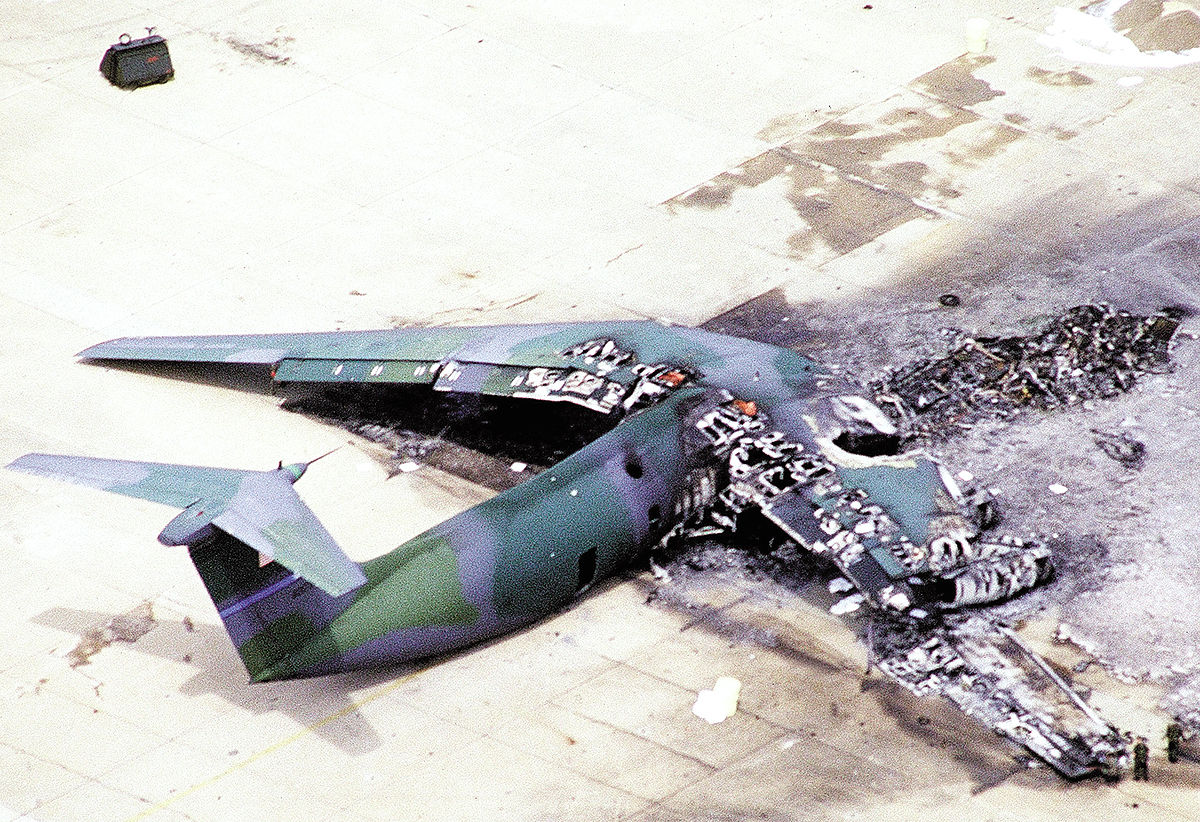
A C-130 and an F-16 had tried to land on the same runway at the same time. At first it was thought to be all Air Traffic Control error, but was later determined to be partly pilot error. The nose of the F-16 severed the C-130E’s right elevator. On impact, the F-16 pilot applied full afterburner to try to recover the aircraft, but it began to disintegrate. The C-130 was able to circle around and land safely. Both pilots ejected from the F16, but their aircraft, still on full afterburner, continued on an arc towards Green Ramp. The F16 hit the ground between two C-130’s and skidded into one of the C-141’s parked next to Green Ramp, puncturing fuel tanks. The explosion hurled the fireball and the F-16 wreckage directly into Green Ramp where the paratroopers were sitting and standing. 2LT Jay Nelson said that he heard two popping sounds (which were the F16 pilots ejecting) behind him and looked back to see the F-16 coming at them. He said, “It looked like it was broken in half and on fire. I took two steps and dove for the ground and the whole world at that point turned orange. It was literally so hot, the air was sucked out of my lungs and I blacked out. I woke up and I was on fire,”
Captain Rich realized that he couldn’t outrun the fireball and dropped to the ground behind the one foot high concrete platform of a mockup. He remembered the sensation of intense heat as the fireball passed over with a weird low pitched roaring sound like that of a blow torch, and debris hitting all around like banging of metal pipes. His back was on fire. Rolling on the ground to put the flames out, he noticed the fireball had gone. Near him was a man “burning like a human torch.” Rich lunged at the soldier and knocked him to the ground. With his bare hands he tried to extinguish the flames, but the soldier’s fuel-soaked clothing kept reigniting. “No matter how hard you patted you couldn’t get the fire out.” He ripped off the man’s shirt and quenched the flames. A few feet away Rich helped another soldier put out spots of fire on the back of a female soldier lying on the ground. He decided to look for others who might need help. It was then that the sheer devastation on Green Ramp hit him: The number of wounded was almost overwhelming. Everywhere there were groups gathered around the injured trying to help them. Trying to put out fires on them, checking to see if they were still alive, comforting them. Others were running around in half panic, half dazed, looking for someone to help or something to do. Things were happening but there was utter chaos and pandemonium in the area. As 2LT Jay Nelson got the fire on his body put out, he saw a chaplain that knew him and his wife of nine months, Beth. He asked the chaplain to call Beth and tell her that he was OK. He wasn’t.
Sgt. Gregory Cowper of the 2d Battalion, 505th Infantry, started rolling when the fire caught up with him. “Ammunition from the F-16 chain guns was going off. I couldn’t tell where it was. I looked to my left and there was a man on fire. I looked to my right and there was a man on fire.” Cowper helped about five or six people before realizing that he had a broken leg. Someone helped him out the gate and into a Humvee for transportation to Womack Army Medical Center. Cowper considered himself lucky.
Sgt. Waddington “Doc” Sanchez, a combat medic with the 2d Battalion, 505th Infantry, “was . . . one of the first to see the explosion come his way….” He yelled for everyone to get down or out of the way. In taking time to warn others, he perished in the fireball’s wake. “He gave the ultimate sacrifice, his own life,” said Lt. Ronald Walker, Sanchez’ medical platoon leader. The father of five had planned to make a career in the Army.
Specialist Estella Wingfield, an information systems operator with Headquarters and Headquarters Detachment, 525th Military Intelligence Brigade, remembered: “A sergeant I didn’t know looked me in the eye, grabbed me by the shirt, threw me several feet in the air and jumped on top of me…. An instant later, I heard the blast, felt the extreme heat from the explosion and the debris falling on us…. After the explosion and the rounds stopped going off, he whispered in my ear, “Crawl out from underneath me.” I did and took off running.” When she realized the sergeant was not running behind her, she ran back to the spot where he had protected her from the explosion. He was dead. Staff Sergeant. Daniel E. Price of the 2d Battalion, 505th Infantry, sacrificed his life to save a female soldier he had never met before.
Sergeant First Class Juan Gonzales of the 44th Medical Brigade was there waiting to make a jump and he had a cell phone. He immediately called Master Sergeant Richard Young in his brigade operations section. All staffed ambulances were immediately directed to Green Ramp. Firing ranges were closed and their ambulances also sent to the scene.
Many people not involved in the accident had rushed onto Green Ramp to offer assistance. They included instructors from the jumpmaster school; medics from Special Forces, who were in the jumpmaster school that day; members of Fort Bragg’s 44th Medical Brigade, who were training nearby; and others who happened to be in the parking lot. The fireball never reached them, but they saw what happened and instinctively went to help.
To transport wounded to the Womack Army Medical Center on Fort Bragg, troops commandeered all sorts of vehicles—trucks, Humvees, military vehicles, and privately owned cars belonging to jumpmaster school students. Instructors, students, Joint Special Operations Command medics, trained medical personnel from nonmedical units, and Air Force personnel, who either had witnessed the explosion or were nearby, tore up the jumpmaster school to make litters of plywood, doors, and black boards, for the victims. “If you could put someone on it, they used it,” said Tech Sgt Ricardo A. Gonzales, an aeromedical technician with the 23d Medical Squadron. Rescuers then drove the casualties to the hospital. Military Police descended on Green Ramp and escorted anything carrying casualties, as fast as they could through Fort Bragg to the hospital.
Specialist Brian Powell, an emergency medical technician, described the Humvees he saw taking injured soldiers to Womack under escort of military police: “The back of the hummer was full of bodies…. They were piled on top of each other and one of the guys was keeping them down, trying to keep them calm. They were black, covered with soot. Some were hurt really bad. All casualties who were still alive were evacuated to Womack’s main hospital within forty-five minutes of the accident, most of them within 30 minutes. Nine were dead at the scene, two died on the way to the hospital, twelve more soon would die of wounds and burns, and one almost 10 months later.
As soon as the 911 alert of the accident at Pope was initiated many things happened almost simultaneously. The 82nd Airborne Division Commander, Major General (MG) William Steele, immediately sent a team to Green Ramp to establish an EOC (Emergency Operations Center) to help verify the names of all the casualties, their status, and their evacuation destination. The Division Chief of Staff, Colonel John Marcello, sent Lieutenant Colonel Randy Standsfield, the Division G1, with some personnel from the division operations section to set up an EOC in the Patient Administration Division of Womack Army Medical Center. There they would build a data base on all the casualties and become the central point of contact for soldiers in the hospital and for family support. MG Steele also ordered the 1st and 3rd Brigade Commanders, Colonel John P Abizaid (future 4 star general) and Colonel John Schmader to immediately conduct casualty assistance training for their officers and non-commissioned officers (NCO’s) (sergeants). The majority of the casualties were in those two brigades.
MG Steele said; “We will take care of families. We will do this. I don’t care what it costs…. This is what we are going to do. This is my intent.” The general’s statement provided direction for his officers and their wives; they worked as partners in the aftermath of the tragedy and facilitated the tasks of the family support group.
The XVIII Airborne Corps Commander, Lieutenant General Henry Shelton, directed that an EOC be established at XVIII Corps Headquarters and at Fort Bragg Garrison Headquarters.
At that same time, Major (Doctor) Craig Corey, the chief of the emergency medical department, at Womack Army Medical Center, activated their mass casualty plan and called in extra emergency room physicians, nurses and medical technicians. Also at the time of the explosion, Brigadier General (BG) (Doctor) Robert Claypool, the commander of Brooke Army Medical Center, which includes the Army Burn Unit, at Fort Sam Houston (San Antonio), Texas, was attending a video teleconference. Upon being interrupted and told of the accident, all participants in the conference were informed, which included the Surgeon General of the Army and the Surgeon General of the Air Force. BG Claypool had a Burn Team already in North Carolina diverted to Fort Bragg, and directed that three more Burn Teams, each consisting of a physician, nurse, respiratory therapist, and an LPN, with sufficient equipment and fluids to handle 40 to 60 burn patients, get in the air to Fort Bragg. The Air Force immediately shipped 20 ventilators directly to Fort Bragg.
MG Steele had a nine man liaison team organized, which departed at 0300 on the 24th for Fort Sam Houston, to provide information back to Fort Bragg and to assist patients and families however they could.
The first two casualties to arrive at Womack were two food venders with minor burns, the next one arrived on a plywood stretcher. He had a leg amputated with a tourniquet held in place with a crow bar. Another had burns on 100 percent of his body. He was treated and transferred to a regional burn facility.
The Head Nurse of the Emergency Room was an extremely competent Major Patricia D Horoho (future 3 star general). Major Horoho’s assignment to Fort Bragg had been like coming home, because she was an army brat, who was born in that hospital and grew up on Fort Bragg. The 22 bed Emergency Room was quickly overwhelmed, so taking advantage of the mild weather, Major Horoho began triage in the driveway. That spilled over into the grass, with the injured on plastic sheets. Volunteer soldiers held sheets up to protect the injured from the view of reporters who had gathered across the street. Practically every doctor, nurse, and medic on Fort Bragg, stopped what they were doing, closed their clinics and rushed to the hospital to help. A hospital spokesperson said, “They just put on gloves and went to work.”
Womack Chaplains went to the Emergency Room before the casualties arrived. They helped carry litters and moved from patient to patient offering consolation and prayer in attempts to calm ” the “frightened injured” and the frantic caregiver.” Chaplains from all of Fort Bragg went to assist families, patients and staff at Womack.
By 10:00 PM that night, the hospital had treated and released 51 casualties, their follow-up care to be on an outpatient basis, and admitted 55. Twenty five to intensive care units and 30 to inpatient wards. Another 13 casualties were transferred to regional hospitals, 7 to the Jaycee Burn Center at University of North Carolina, Chapel Hill, 5 to Cape Fear Valley Medical Center, and 1 to Highsmith-Rainey Memorial Hospital, both in Fayetteville. There were 130 casualties from the Green Ramp disaster.
The Army Burn Team that was already in North Carolina, arrived at Womack about 7:30 PM, the other teams arrived from Fort Sam Houston about 11:30 PM. They immediately evaluated the 55 patients admitted to Womack, and selected 20 to be transferred to the Army Burn Unit. An Air Force C9 Nightingale Medivac plane, with the first 11 burn victims, took off from Pope Air Force Base at 7:20 AM. Another C9 took off at 12:50 PM with the remaining nine. They were wrapped in aluminum-lined blankets to keep their bodies warm, and thirteen were on ventilators.
At battalion level, disseminating information, notifying and caring for families, and caring for the needs of the casualties fell squarely on the unit commanders. The majority of the casualties were in the 2nd Battalion of the 504th, commanded by Lieutenant Colonel (LTC) Stanley McChrystal (future 4 star general) and the 2nd Battalion of the 505th, commanded by LTC Lloyd Austin future 4 star general and Secretary of Defense). LTC McChrystal established a battalion EOC at battalion headquarters under the command sergeant major and the S-3 (operations officer). He also set up a small command post at Womack and for three hours on the 23rd, on the airfield. LTC McChrystal ordered the two units that were away training to return to Fort Bragg, prohibited early dissemination of information about casualties, and tried to bring the wives of his injured paratroopers into the company areas to ensure that they received the care and support they required. He stayed at the hospital command post until 0500 on the twenty-fourth, creating master lists of tasks and the people to perform them. He sent soldiers from each company to Womack to serve “almost as reaction type guys,” to take care of “the thousand little things that would come up.” He appointed liaison people to be with the families of casualties, whether dead or alive, and soldiers to participate in the next-of-kin notification process. He coordinated everything with corps, division, and brigade personnel and “got tremendous support from them.”
Beth Nelson made it to the hospital to find that Jay was in surgery to relieve the swelling from the burns. She was led to a room with other Family members. She said, “”This young Soldier in PT clothes kept going back between the doctors and me to tell me what was going on with Jay. I don’t know who he was but he stuck with me for the afternoon.” She finally went home to wait for a call about when Jay would be moved to San Antonio. The battalion commander’s wife, Anne McChrystal, called her that Jay was back in surgery. When she arrived back at the Family Room in the hospital, the look on Anne McChrystal’s face scared her. “Just tell me he’s alive. That’s all I want to know”, she said. Anne answered “He’s alive.” She had intended to tell Beth that they didn’t expect Jay to make it through the night, but didn’t, and he did make it. Beth did get to see her husband that night. She said, “He didn’t look anything like Jay. I went home and prayed all through the night.” The next morning she was on the plane with Jay, along with family members of the other injured who were on board, to the Army Burn Unit at Fort Sam Houston. They would be there for two months.
Emergency medical evaluation boards were established to provide early retirement for the soldiers who were near death in order to increase their dependents’ benefits; the widow would receive the retirement and the child the death indemnity compensation, about $750 a month. The division EOC had to ascertain who was married, who had children, who was critically injured, and who should be processed first among the casualties. Because of this effort, only one soldier with children died before the division was able to retire him early. “Retiring people was a focused effort, day and night,” recalled Colonel Stansfield, who coordinated the work with the XVIII Airborne Corps casualty assistance personnel. General Steele recalled that “Corps, Department of the Army, all of them just opened the door and said: ‘Call. We have the board ready; we can do this procedure in a matter of minutes.’ Things that would take a year when it’s not a crisis were happening in a matter of minutes over the phone.” Later, the corps recommended clarification of Army policy to allow posthumous medical retirement for all casualties.
A nucleus of military wives arrived at Womack shortly after the accident and stayed until the early hours of the morning, providing support to the families that gathered there. They gave hugs, held hands, listened, obtained food, made contacts for plane tickets, and did what was necessary to organize assistance. According to Pam Steele, the wives dealt with the emotions by keeping a sense of levity, a sense of humor; by talking about the accident; and by “feeling the sorrow.”
The Fayetteville and Fort Bragg communities have traditionally come together in times of trouble. But the magnitude of the tragedy on Pope Air Force Base resulted in a new level of community response. The community shared the enormous grief and offered untold practical assistance. When asked what they needed, the Womack staff said, first would be food to feed these hundreds of extra people working in the hospital and for the people waiting for word about their loved ones. Pizza Hut immediately sent free Pizzas to the hospital, and when the word got out, food started pouring in from McDonalds, Taco Bell, Hardees, Papa John’s, Domino’s Pizza, and Kentucky Fried Chicken. The Fayetteville community flew their flags at half-staff, and drove with their head lights on during the day. Housewives baked brownies and cookies and delivered them to the post. People donated money that the family support group set aside for the families. Bags of food and toiletries showed up in the foyer of the Fisher House, where families of sick soldiers stayed. Hundreds of volunteers offered their time and energy. The Fayetteville Regional Airport reserved two runways for military use.
Two days after the accident, President Bill Clinton toured the crash site and visited the Green Ramp casualties at Womack. Clinton talked to the injured paratroopers for about an hour and then mingled with the crowd that gathered outside the hospital. At a press conference in front of Womack the president spoke of the soldiers’ courage and spirit: “I wish everyone in America could see the faces and the eyes and the spirit of these people. They would realize how fortunate we are to be served by men and women like them. They are so brave and selfless.” Also on that day, the Secretary of Defense, the Chief of Staff of the Army and the Chief of Staff of the Air Force visited those in the hospital.
The XVIII Airborne Corps chain of command visited the injured paratroopers and their families as well. General Steele, as the 82d Airborne Division commander, involved himself with his wounded troops, calling on them frequently. He spoke of the phenomenal spirit of American soldiers. “They will not lie down and quit . . . even when the Lord deals them a blow like this…. They do not give up. Soldiers, with their eyes swollen shut and their hands burned and bandaged so you could not touch them, would say to you when you visited: “Airborne all the way, Sir!”
General Steele also made several trips to Fort Sam Houston to visit the troops in the Burn Unit. His first visit was on March 26th, in the Secretary of the Army’s C-20 airplane. Accompanying him were my old friend, Division Command Sergeant Major Steve Slocum (we were in the same company in Italy, he was run over by a cow out in a training area, no injury, just funny and embarrassing); Colonels Schmader, Abizaid’ and McChrystal; the division chaplain, Lt. Col. Jerome Haberek; and the division surgeon, Maj. Jeffrey B. Clark. They all wore their battle dress uniforms and maroon berets. Pam Steele, Kathy Abizaid, and Anne McChrystal also accompanied the group. General Steele felt that “it was important to take the ladies with us,” since women have the facility to comfort and console. During the visit General Steele showed how much he cared about his troops: He cried with them, he held their hands, and he prayed with them. Later, he would say that he “learned from the whole process that there is nothing wrong with showing your emotions.”
The road to recovery was long and painful for many. Therapy, rehabilitation and surgeries, lasting for months and in some cases for years. Lieutenant Jay Nelson, with burns on his back, legs, and hands, had five skin grafts and ten other surgeries, enduring nearly unbearable pain. The key to his survival was his refusal to quit. “I just grit my teeth and . . . just try to gut it out,” recalled Nelson, hoping each time to be able to “just hold on a little bit longer.” At age twenty-four, he had to learn again how to walk and how to feed himself. A year later he needed more surgery. “Scar tissue pulled his left thumb back to a strange angle.” Cold weather brought on stabbing pains in his hands, and his back and legs itched. Although no longer able to be an infantry soldier, he did remain on active duty, and two years ago was a Lieutenant Colonel commanding the Warrior Transition Unit at Fort Bragg.
Many, no longer able to be combat soldiers went into the medical field, both in and out of the military. Some became nurses, LPN’s, physical therapists, and many into counseling patients with serious injuries.
One of the first casualties from the 2d Battalion, 505th Infantry, to be airlifted to San Antonio on March 24th was Sergeant Christopher “Chris” J. Burson. He remembered nothing that had happened to him on Green Ramp, in the emergency room at Womack, or on the flight to San Antonio. With burns on his feet, legs, hips, and hands and with part of his left ear missing, he woke up delirious in the burn unit. He experienced more mental anguish than physical pain because, in his words, “all the nerve endings in my legs were burned and dead.” He endured painful scrubs and underwent three skin grafts and six surgeries. Three weeks after the accident his spirit soared on the day he took his first few steps; “it was like being a baby again learning to walk.” To his delight, Burson discovered that he enjoyed occupational therapy. He practiced stepping on and off a 4-inch block and picking marbles out of playdough with his stiff left hand. Before the accident Burson had aspired to a career in the infantry, with a lifelong dream of becoming a sergeant major, but now, as soon as he was sufficiently recovered, he wanted to become an occupational therapist. “God makes things happen for a reason,” he said.
Leadership was evident throughout the response. Officers and noncommissioned officers, commanders, and command sergeants major, supported by their spouses, became personally involved in the welfare of the 130 Green Ramp casualties and their families, as well as those who were not injured but affected by the crash. By taking charge of the response, unit leaders decisively influenced the process. I have often written about quality of officers assigned to the 82nd Airborne Division and Fort Bragg. The XVIII Airborne Corps Commander, LTG Henry Shelton, retired as the Chairman of the Joint Chiefs of Staff, MG William Steele retired as a three star, Colonel John Abizaid retired as a four star, as did LTC Lloyd Austin, and LTC Stanley McChrystal, and the competent nurse Major Patricia D Horoho, retired as a three star Lieutenant General, as the first nurse to be Surgeon General of the Army.
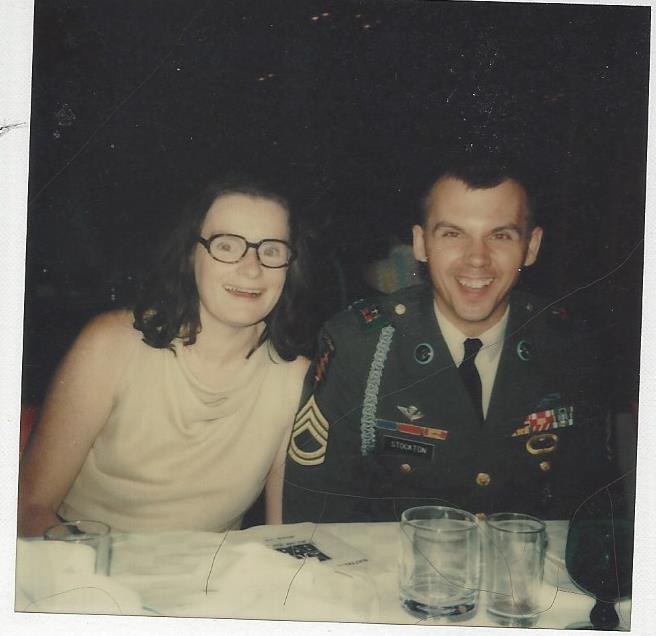
YOUNG LOVERS – High School – Marriage – Enlist

This was originally published in The Belle Banner, Belle Missouri August 29th 2018. If you would like to see the current articles as they are published, you may subscribe to The Belle Banner by calling 573-859-3328, or email tcnpub3@gmail.com, or mail to The Belle Banner, PO Box 711, Belle, MO 65013. Subscription rates are; Maries, Osage, and Gasconade County = $23.55 per year, elsewhere in Missouri = $26.77, outside Missouri = $27.00, and foreign countries = $40.00.
Jack and Judy are a married couple, Jack has been in the Army about eight months, and this is their story.
Jack and Judy started “going steady” when they were about 15, by 16 when Jack got his drivers licenses, they were a couple. Both are from good families and both are smart people. I don’t discount young love as “puppy love”. There were 52 of us who graduated from Belle High School in May 1961. Eleven members of that class married each other or someone one class up or one class down, and all but one couple have remained married to each other as long as they lived, and that one couple separated late in life after their kids were grown. Some of those relationships started before high school. So love is love, and if it is real, it is real.
Both Jack and Judy’s families are middle class working people, not rich, not poor, plus Jack has a sibling a year older who would be first in line for college. Both families wanted the kids to go to college, get an education and a better job for a better life. Jack suspected that if he wanted to go to college he would have to work his way through or borrow the money. Jack and Judy wanted to get married, and they didn’t want to wait four years. Someone suggested three years in the military and college would paid be for by the government. At first they discarded the thought. Although of very strong character and personality, Jack is not a brawny jock, he is more inclined to brain work than muscle work. Could he make in the military? Could they afford to get married? Could they be together? After some research, they began to consider the idea. Jack wanted to be in a good unit with high morale, and fast promotions, but have a job where he could be home at night, and that would allow him the time to accumulate college hours. He learned that the military tuition assistance is $250 per semester hour for up to 16 semester hours per year, and that most colleges on Army posts have reduced their price for active duty students to $250 per semester hour for both evening and online classes. They questioned that if Jack did enlist should they wait to get married until he was through his training. They were told a definite no, absolutely get married before being sworn in, and to have that state marriage certificate with him when he processed in.
After much research, Jack selected Army MOS (military occupational specialty) 74D Chemical Biological Radiological and Nuclear Specialist (CBRN) with the airborne option. There were several reasons for that choice. First, it was available. There are a gazillion 74D’s. One in every company in the Army, another at battalion headquarters, and some at brigade level. Promotion to Sergeant is fast, many have made it in two years. All of the company level jobs call for a Sergeant E5, and those are the positions to which many new 74D’s are assigned. Another attraction was autonomy, Jack read that in many units the 74D does about everything but 74D work, whereas in the airborne units the NBC NCO (Nuclear Biological Chemical) (Non-commissioned Officer) is an important position in the company headquarters, because those units frequently conduct CBRN training. And finally, a big consideration was that the 11 week AIT (Advanced Individual Training) for 74D is at Fort Leonard Wood. The airborne option almost guarantees (probably 90%) an assignment to the 82nd Airborne Division at Fort Bragg, North Carolina. The 82nd has the highest morale in the Army, it pays an extra $150 per month, and a Private can get on post family housing immediately. If, in the slim chance, he wasn’t assigned to Fort Bragg, it would be to Italy or Alaska and Judy could go with him and get government housing or be paid a housing allowance for off post housing.
High School graduation, marriage and then Army. In addition to his own drivers’ license and social security card and a voided check (all army pay is by direct deposit), Jack had their marriage certificate, Judy’s birth certificate and her social security number. During in-processing at the reception station, Jack enrolled Judy in DEERS (Defense Enrollment Eligibility Reporting System), which gave her access to all benefits such as medical, dental, travel, etc, and started their BAH (Basic Allowance for Housing). He obtained the paperwork for Judy to get her ID Card. Judy continued living at home with her parents.
Assuming that Jack enlisted on the first day of a month, the first money deposited in their bank account on the 15th of that month was around $770, because Jack was given a government debit card with $350 on it, to purchase necessary items for basic training, which was deducted from the first pay. The next check on the 1st of the following month was $1,090. After 30 days, Family Separation Allowance of $250 per month started, so after that, about $1,215 was deposited in their account on the 1st and on the 15th of each month.
After a few days processing at the reception battalion, Jack’s group was delivered to their basic training company. After the initial Drill Sergeant blitzkrieg, they were assigned bunks and wall lockers and marched to pay phones to call home with their address. Jack and Judy communicated by mail. On Sunday after the third week, Jack got to call home again. Jack got to spend a day with Judy during one “on post pass” toward the end of basic training, and then there was “family day” the day before graduation. Both families went to see Jack graduate from basic.
After graduation, Jack moved a few blocks to the new CBRN training facility. That time he got to keep his cell phone and computer, just couldn’t use them during duty hours (class). That was a new facility with three men to a room with three desks, three closets and a bath/shower. Down stairs was classrooms and offices. Every company in the Army has a CBRN room, sometimes called an NBC room, where protective masks, and MOPP suits (That is an acronym for Mission Oriented Protective Posture. It is basically a rubber (not really-special chemical compound) suit. Top with hood, bottom, boots, and gloves all attached together to keep unseen things from getting to your skin. It’s hot! Training in MOPP gear in the winter is not too bad, it just tires you out soon, in the summer it is hell. Detection equipment, decontamination material, and chemical antidotes are also maintained in the CBRN room. AIT covered biological agents, chemical agents, radiation detection and response, hazardous materials/toxic industrial chemicals, operational decontamination, thorough decontamination, mass casualty decontamination, and basic chemical/biological detection. Plus CBRN room operations, supply, maintenance and training. The CBRN Specialist or NCO is also the most knowledgeable person in the company on CBRN training, which makes him or her an integral part of training in a company that does CBRN training. In AIT Jack went over four months’ time in service, which raised his pay by about $100 per month. During AIT, Judy was at the Fort every weekend. The first three weeks Jack got “on-post” passes, then off post passes.
Jack continually monitored his AKO account (Army Knowledge Online) and particularly the ASK key (Assignment Satisfaction Key). Toward the end of AIT Jack saw that he was tentatively scheduled for assignment to the 82nd Airborne Division, which he had been requesting, but “chat” told him that orders would not be issued until he successfully completed airborne school. He requested that his orders reflect a move with dependents, so the Army would pay for moving some household goods they had obtained, and pay them a dislocation allowance for the move. He also requested 10 days leave, between airborne school and reporting to Fort Bragg. Jack completed the online request for family housing on the Corvias Housing site for Fort Bragg, then called them and gave his tentative report date. He was told to email them his orders as soon as he received them and they would give him an address of a “move in special”, which he agreed to accept. He then visited Post Transportation on Fort Leonard Wood and completed paperwork for the move to Fort Bragg, he just had to email them his orders when he received them. Finally 74D graduation on a Thursday. Judy was able to drive him to the airport in St Louis where he caught a flight on Friday to Columbus Georgia (had to change in Atlanta) for airborne school at Fort Benning, Georgia.
Three weeks, ground week, tower week and five jumps later, Judy drove down to Fort Benning on Friday and pinned “jump wings” on her new paratrooper. They drove back home together and got ready for the movers, who would be picking their goods up in a couple days. They split their 10 days between home and Fort Bragg, they wanted to get settled before Jack had to report in. The quarters they got was a two bedroom duplex. It was an older house in an older housing area, but recently renovated. Jack’s BAH paid for rent, utilities, lawn maintenance, trash pickup, access to a community pool, and a community center. Their goods arrived and they bought a few things they needed to set up housekeeping.
Jack reported in to the 82nd Airborne Division Replacement Detachment, spent three days drawing gear and processing into Fort Bragg. He was assigned to a company to replace the company CBRN NCO, who was in the process of leaving. Jack had only a few days to get oriented before the Sergeant left, but being the smart guy that he is, he quickly got a grasp on the CBRN Room. He meticulously counted all items and signed for the room. He studied the training schedule and questioned the Supply Sergeant and the First Sergeant about what CBRN items may be needed for what training.
Jack went over six month time in service about the time he arrived at Fort Bragg so he was automatically advanced to Private E2, which was another $100 raise, When they moved into government family housing he lost the BAH, but he gained $150 jump pay and $370 per month for meals since he wasn’t living in the barracks. So, now as a PFC (Private First Class) E3, at eight months in the Army, after taxes and SGLI (Serviceman’s Group Life Insurance) are deducted, about $1,075 is deposited in their bank account on the 1st of the month and again on the 15th of the month. That equals a weekly take home pay of just under $500, which for a 40 hour week would be around $15.00 per hour. Throw in complete health care coverage and a house with all utilities and Jack is making the equivalent of a civilian making $20.00 an hour or over $40,000 a year.
Jack and Judy are fictional characters, but the process and the figures are real, based upon 2019 pay scale.

A NATIONAL CRISIS

This was originally published in The Belle Banner, Belle Missouri October 17th 2018.
The fiscal year of the federal government is October 1st of this year to September 30th.of next year. Last fiscal year the US Army failed to meet its recruiting goal. The Army’s original recruiting goal for Fiscal Year (FY) 2018 was set at 80,000 new recruits. In April that goal was reduced to 76,500 due to increased reenlistments. The recruiting goal was set to increase the size of the Army from the current around 476,000 to around 500,000 soldiers. About 70,000 new soldiers were enlisted in FY 2018. The goal was to have 483,500 by the end of FY 2018, the Army still has around 476,000 soldiers.
The New York Times recently published an article which said that the Army missed its goal even after lowering standards to let in more troops with conduct or health issues. That was an incorrect statement. Standards have not been lowered. Standards were lowered in 2007 during the surge in Iraq, after which the Army saw spikes in behavioral and other problems. The Secretary of the Army and the Chief of Staff of the Army have vowed that standards will not be lowered. Brigadier General Kevin Vereen, the Deputy Commander of the US Army Recruiting Command recently hinted that some waivers of disqualifications may be considered, which have not been previously. He said that some of the disqualifications are mind-boggling, such as eczema (irritated skin) and minor misconduct that boils down to kids being kids. He said; “There are some people who should be given the opportunity to join the Army and have not been given a fair shake.” He said there has to be a balance, he doesn’t want to see new recruits enter the Army and become immediate misconduct problems for commanders. He said the Army will not sacrifice quality for quantity.
A roaring economy makes recruiting for the Army tougher, and the United States has the lowest unemployment rate since 1969. Plus 75 percent of people in the United States between the ages of 17 and 24 are ineligible to join the military, even if they wanted to. According to reports, that means 24 million of the 34 million of that age group are not qualified for military service. About 25 percent of those entering recruiting stations nationwide cannot pass the Armed Forces Qualification Test. That leaves a very small group of people available to recruiters. The Army’s plan is to offer more money in enlistment bonuses and put more recruiters on the street.
Aside from walking in Indian country knowing you’re being watched, Army recruiting duty is one of, if not the most, stressful jobs in the Army. A small percentage of Army Recruiters volunteer for the duty, most are assigned by Department of the Army Headquarters to that duty. In 2008 Sergeant First Class Patrick Henderson a 35 year old combat veteran of Iraq, who suffered from PTSD, had been on recruiting duty for a year when he went into his backyard shed, locked the door and hanged himself with a dog chain. He was the fifth recruiter suicide in seven years in that Recruiting Battalion. Since 2001 there have been 17 Army Recruiter suicides. SFC Henderson’s suicide caused an investigation by Department of the Army, after which recruiting quotas were changed from individual quotas to station missions. That change allowed recruiters in an Army Recruiting Station to work together as a team, instead of each individual working alone. It has helped.
But, could this be the hint of a much deeper problem than the Army missing a recruiting goal one year. We’ll just throw in more money and recruiters and make it up next year. That may not be possible, considering the people available. Economics are keeping some of the world bad guys in check, but their thirst for power is obvious. China’s Navy is becoming very aggressive in the South China Sea and in particular around US Navy ships. Russia is aggressive in Eastern Europe and next door to Alaska. Hopefully North Korea is being brought under control. And then there is the leader of Iran shouting “Death of America”. At the height of World War II the United States of America had over 12,000,000 men in uniform. Today we have about 1,350,000 on active duty and another 800,000 in the Reserves and National Guard. So if we wake up one morning and were in a major war, where do we get the people to defend this country? Return to the draft?
China, Russia, North Korea, and Iran all have mandatory military service, plus 22 other countries, including Austria, Brazil, Denmark, Finland, Norway, Mexico, Switzerland, and Israel which requires men and women to serve in the military. No politician is interested in reinstating the draft and neither is the military, but what if we have to. Lowering the standards may be necessary, but it would have consequences. When men were drafted they took all the tests, just like now. The AFQT (Armed Forces Qualification Test) results are divided into four categories, if a draftee scored in category four, the lowest, he was rejected from military service. During the Vietnam War, Defense Secretary McNamara decided to allow 100,000 category four’s into service. They were called “McNamara’s 100,000”, and they caused many problems. I had four infantry privates, who had graduated from college and were drafted. They caused no problems, McNamara’s 100,000 caused a lot of the drug, fragging, and race problems in Vietnam. So what’s the answer, draft all the overweight, but otherwise qualified people and put them through several weeks of weight reduction, health, and strength training prior to basic training – possibly.
This could be a National Security crises. In February, The Heritage Foundation published a report that elaborated on the causes of this crisis. Of the 75 percent of the ineligible 17 to 24 year old people, 32 percent are because of health problems primarily obesity. The number of overweight kids grows every year. Improper diet, lack of physical activity, and too much sugar are the big culprits. Carbonated high sugar content soft drinks like Coke, Pepsi and all their derivatives cause weight gain. Too much consumption along with chips or candy causes a lot of fat weight gain. I wonder if not having a Home Economics Class has anything to do with this. We now have a couple generations of mothers who have not had a class on setting a table and planning a nutritious meal. Inadequate physical fitness accounts for 27 percent. People who have never exercised or performed hard physical work, plus not following a proper diet, often takes many months of strict regimen to get their bodies in good physical condition. Lack of education, a high school diploma, is the problem for 25 percent. Current policy for those with only a GED is that they must have 15 semester hours of college before they can enlist. A full 10 percent are disqualified because of criminal history. The Department of Justice reported that in 2015 nearly one million juveniles were arrested, and according to The Pittsburg Youth Study 52 to 57 percent of those continue to offend up to age 25. In 2016 a third of all Americans had used marijuana within the past year and 50 percent in their lifetime. Sexual offensives and drunk driving prevent many from being able to enlist in the military. Kids involved in good organized programs like Boy Scouts, Girl Scouts, junior ROTC, and 4H don’t usually fall into this category. Belle High School is fortunate to have Mr. Chris Mertz, and now with the help of Mrs. James, guiding a tremendously successful FFA program. It is popular with the students and is producing good citizens.
What would happen if the draft was reinstated? Riots? The military is one percent of the US population. There has become such a disconnect between the general public and the military, that the military, and the wars in Iraq and Afghanistan have been largely ignored by a majority of people. Military service is almost becoming a family business. Children of career military people become career military people. Alabama, a state of 5 million people sends more people to the military than the cities of Los Angles, Chicago, and New York combined which have an area population of over 40 million, according to an Army colonel in April. Up until the Vietnam War most men accepted the call, when drafted, served their time, did their duty and came home. Some celebrities answered the call when they were drafted, some did not.

With the probability of going to war in Vietnam, protests, riots, and draft card burnings made national news. Some actually moved to Canada to avoid being drafted.
Serving in the military is a noble and honorable thing to do. Whether a combat infantryman, a cook in the chow hall, a clerk behind a desk or a mechanic in the motor pool, serving is an honorable thing to do and with that service should be pride. Society in the United States of America has changed much and not necessarily for the better since January 20th 1961, when in his Inaugural Address President Kennedy said; “Ask not what your country can do for you; ask what you can do for your country.”

MEDAL OF HONOR – ROY BENAVIDEZ

This was originally published in The Belle Banner, Belle Missouri October 10th 2018.
I met Roy Benavidez in May 1966, after I had been promoted to Staff Sergeant and reassigned from the 3rd Battalion to the 2nd Battalion 325th Infantry of the 82nd Airborne Division. I was assigned as the Personnel Sergeant for a month before I went to Vietnam. Sergeant Roy Benavidez was also an infantryman working in the S1 (Administrative) Shop doing jobs for the Sergeant Major and some reenlistment paperwork. At the time, to me, he was just a happy Mexican sergeant, bouncing along doing his job. What I didn’t know, at the time, was that he was just getting back into shape after weeks of drinking and pain pills because of extreme pain. In October 1965 he had gone to Vietnam as an advisor to a South Vietnamese Infantry unit, and stepped on a land mine. The mine didn’t explode, but the ignition charge blew the whole mine into his butt. He was evacuated to the Army Medical Center at Fort Sam Houston, Texas, where he was told that he would never walk again.
At Fort Sam Houston he was wheeled into “wheel chair therapy” classes with amputees, where they were taught how to live in a wheel chair. Doctors told him that they would start processing a medical discharge for him, but Roy Benavidez was determined to walk and to stay in the Army. At night, against doctors’ orders, he would get out of bed and crawl to the wall where he would try to push himself up. Enduring the most excruciating pain, he would sit against the wall, pull his knees up and try to push. He first got his toes to wiggle, then he was able to put his feet flat, and finally push up against the wall, to the cheering of the other patients. Finally, with his wife at his side determined not to show the extreme pain he was experiencing, he walked into the doctors’ office and demanded that he be allowed to return to active duty. He was assigned to the 2nd Battalion 325th Infantry at Fort Bragg. Still in the most unbearable pain, he saw a doctor friend, on the sly, who gave him Darvon prescriptions off the record. As soon as he got off work he went to the club and drank until he could go home and go to sleep. He said that the Darvon helped him make it through the day, and the alcohol helped him sleep at night. Finally when the doctor told him that he was killing himself, he quit both cold turkey and started running. That’s when I met him. We both left about the same time. I went to Vietnam, and he went to Special Forces training.
On February 24th 1981 President Ronald Reagan presented the Medal of Honor to Master Sergeant, then retired, Roy Benavidez. Before reading the citation, the President turned to the press and said; “If the story of his heroism was a movie script, you would not believe it.” The thirteen year delay from the time of the action to the presentation was due to the mission being classified until 1980, and finding an eye witness still alive. The official citation;


“Master Sergeant (then Staff Sergeant) Roy P. Benavidez United States Army, who distinguished himself by a series of daring and extremely valorous actions on 2 May 1968 while assigned to Detachment B56, 5th Special Forces Group (Airborne), 1st Special Forces, Republic of Vietnam. On the morning of 2 May 1968, a 12-man Special Forces Reconnaissance Team was inserted by helicopters in a dense jungle area west of Loc Ninh, Vietnam to gather intelligence information about confirmed large-scale enemy activity. The area was controlled and routinely patrolled by the North Vietnamese Army. After a short period of time on the ground, the team met heavy enemy resistance, and requested emergency extraction. Three helicopters attempted extraction, but were unable to land due to intense enemy small arms and anti-aircraft fire. Sergeant Benavidez was at the Forward Operating Base in Loc Ninh monitoring the operation by radio when these helicopters returned to off-load wounded crewmembers and to assess aircraft damage. Sergeant Benavidez voluntarily boarded a returning aircraft to assist in another extraction attempt. Realizing that all the team members were either dead or wounded and unable to move to the pickup zone, he directed the aircraft to a nearby clearing where he jumped from the hovering helicopter, and ran approximately 75 meters under withering small arms fire to the crippled team. Prior to reaching the team’s position he was wounded in his right leg, face, and head. Despite these painful injuries, he took charge, repositioning the team members and directing their fire to facilitate the landing of an extraction aircraft, and the loading of wounded and dead team members. He then threw smoke canisters to direct the aircraft to the team’s position. Despite his severe wounds and under intense enemy fire, he carried and dragged half of the wounded team members to the awaiting aircraft. He then provided protective fire by running alongside the aircraft as it moved to pick up the remaining team members. As the enemy’s fire intensified, he hurried to recover the body and classified documents on the dead team leader. When he reached the team leader’s body, Sergeant Benavidez was severely wounded by small arms in the abdomen and grenade fragments in his back. At nearly the same moment, the aircraft pilot was mortally wounded, and his helicopter crashed. Although in extremely critical condition due to his multiple wounds, Sergeant Benavidez secured the classified documents and made his way back to the wreckage, where he aided the wounded out of the overturned aircraft, and gathered the stunned survivors into a defensive perimeter. Under increasing enemy automatic weapons and grenade fire, he moved around the perimeter distributing water and ammunition to his weary men, re-instilling in them a will to live and fight. Facing a buildup of enemy opposition with a beleaguered team, Sergeant Benavidez mustered his strength, began calling in tactical air strikes and directed the fire from supporting gunships to suppress the enemy’s fire and so permit another extraction attempt. He was wounded again in his thigh by small arms fire while administering first aid to a wounded team member just before another extraction helicopter was able to land. His indomitable spirit kept him going as he began to ferry his comrades to the craft. On his second trip with the wounded, he was clubbed with additional wounds to his head and arms before killing his adversary. He then continued under devastating fire to carry the wounded to the helicopter. Upon reaching the aircraft, he spotted and killed two enemy soldiers who were rushing the craft from an angle that prevented the aircraft door gunner from firing upon them. With little remaining strength, he made one last trip to the perimeter to ensure that all classified material had been collected or destroyed, and to bring in the remaining wounded. Only then, in extremely serious condition from numerous wounds and loss of blood, did he allow himself to be pulled into the extraction aircraft. Sergeant Benavidez gallant choice to join voluntarily his comrades who were in critical straits, to expose himself constantly to withering enemy fire, and his refusal to be stopped despite numerous severe wounds, saved the lives of at least eight men. His fearless personal leadership, tenacious devotion to duty, and extremely valorous actions in the face of overwhelming odds were in keeping with the highest traditions of the military service, and reflect the utmost credit on him and the United States Army.”

When the enemy soldier clubbed him from behind it knocked him down and broke his jaw. The NVA soldier then tried to stab Benavidez with a bayonet on his rifle, Roy grabbed the bayonet, knowing it would cut his hand, and pulled the enemy to him while he stabbed the NVA with his knife in his other hand. From that point on he couldn’t talk because of the broken Jaw. When he was pulled into the helicopter, he was trying to hold his intestines in his stomach. He was unconscious when the helicopter landed. Thinking he was dead, the medics put him in a body bag, and a doctor who was checking the bodies in the body bags started to zip up Roy’s bag. Roy said he woke up and realized where he was, but he couldn’t talk. He said he could hear that zipper moving and he then said that he made the greatest shot of his life, he spat in the doctor’s face.
After being stabilized in Vietnam, Roy Benavidez was moved to the Army Medical Center at Fort Sam Houston, with over thirty wounds. While he was there, General William C. Westmoreland, the Chief of Staff of the Army, flew to Fort Sam and awarded Roy the Distinguished Service Cross.


Roy had a mentor and friend from Special Forces training who was killed while in Detachment B-56. Roy couldn’t find out much about how he died, because most of what B-56 did was classified, but Green Berets talk to Green Berets. I can tell you from personal experience, spend a little money and a few nights at the Special Forces Playboy Club at Nha Trang, the SF headquarters, and you could get a lot of information. Roy requested and got an assignment to B-56 and soon acquired a reputation for being a stand up fearless guy in action. Everyone in SF had a radio call sign not associated with their real name. Roy’s was Tango Mike/Mike. That mean Mexican, but Roy was only half Mexican, his mother was a Yaqui Indian. The Yaqui were the fiercest Indian tribe in North America, even the Apache would not enter Yaqui lands.
Roy retired from the Army in 1976, and after the Medal of Honor presentation in 1981 he became a motivational speaker to school students. He was in demand all over the world, and many of his speeches are still on youtube. He wrote a book about his life titled, “Medal of Honor – One man’s journey from poverty and prejudice.” He once said; “Faith and perseverance will win out over sheer ability every time.”
Roy died from diabetes complications November 29th 1998. He was 63. He is buried in the Fort Sam Houston National Military Cemetary.

LOVE AND THE ARMY – HAPPY VALENTINE’S DAY

This was originally published in The Belle Banner, Belle Missouri February 14th 2018. If you would like to see the current articles as they are published, you may subscribe to The Belle Banner by calling 573-859-3328, or email tcnpub3@gmail.com, or mail to The Belle Banner, PO Box 711, Belle, MO 65013. Subscription rates are; Maries, Osage, and Gasconade County = $23.55 per year, elsewhere in Missouri = $26.77, outside Missouri = $27.00, and foreign countries = $40.00.
Happy Valentine’s Day! The day to talk about love, so this is about love in the Army.
When I enlisted in the Army, in 1961, most soldiers, including the sergeants were single. There was a saying; “If the Army wanted you to have a wife they would have issued you one.” Now over 60 percent of soldiers are married with children. The soldier’s family has become an integral part of his unit, through his company’s “Family Readiness Group” (FRG). Every company has an officially sponsored FRG, which is comprised of the spouses of the soldiers. FRG leaders receive formal training and are designated as the point of contact to keep the wives and house husbands informed about what training and deployments are upcoming, and especially about what is happening when the soldiers are deployed. The FRG’s have monthly meetings, and during deployments the wives look out for each other, if one is sick there is usually another to help with kids and house.
There is much discussion about the “problem” of soldiers marrying too young, and the marriage doesn’t last. It is a problem. There are nearly 40,000 Army soldiers who are single parents, and have custody of children, but that is also true in civilian life. The Center for Disease Control reports that 48 percent of 18 year olds who marry will divorce within 10 years. That doesn’t mean that the other 52 percent lasts forever, it just means that they made to the 10 year mark. A single parent cannot enlist in the military, but if a soldier becomes a single parent, while on active duty, they can stay, but there are rules. There are also almost 20,000 dual army couples currently serving in the army. That is nearly another 40,000 soldiers married to another soldier. Throw in the Navy, Marines, Air Force and Coast Guard and that figure grows to over 80,000 dual military couples.
Soldiers in the Continental United States do not need their commander’s permission to get married. Officers and enlisted cannot date. That is fraternization, therefore they cannot marry. However, if two enlisted people are married and one becomes an officer that is OK. People, especially young people, fall in love. I’ve read several comments from young soldiers warning others not to get married in AIT (Advanced Individual Training). That may sound funny or absurd to some, but consider that many of those young people, in the army, are away from home for the first time, and they are thrown together in training with the opposite sex. The longer AIT’s that are more relaxed, are where many of those marriages happen. The “Health Care Specialist” (Combat Medic) AIT is 16 weeks long and fairly relaxed, I’ve read several comments from medics warning new recruits not to get married in AIT.
The Army has an official program called the “Married Army Couple Program” (MACP). When two soldiers marry, each has to apply to be placed in the program, then the Army makes every effort to assign married couples to the same location. When a dual military couple or a single parent soldier arrives at a new duty station, they must submit to their commander, within 30 days a written “short term family care plan” and a “long term family care plan”. Short term care is some local, non-military person at that station, who can pick up and care for the kids for a few days. That is usually the civilian wife of a soldier. The longer soldiers are in the Army the easier it is to find short term care providers, because they usually know people at new duty stations. Short term providers must agree in writing to care for the children 24 hours a day, 7 days a week, in the event the soldier is called to duty or deployed with no notice. Long term care providers do not have to be local, but transportation must be prearranged, as well allotments for financial support of the children, powers of attorney, etc. Designated care providers are given access to post facilities, such as commissary, post exchanges, hospitals and clinics, in order to care for the military dependent children.
Occasionally young soldiers get married for the wrong reasons. Army life is easier for married privates and specialists than for single soldiers. The married soldiers live at home, off post or in government family housing, and if two soldiers marry both receive basic allowance for housing (BAH), and money for meals. Any marriage for any reason other than each being insanely in love with the other will probably not last. Sometimes young married privates and specialists get themselves into money problems, thousands do not. A Private E-2 (slick sleeve) married with one child, at Fort Leonard Wood, but living off post, will take home, after taxes and deductions, about $1,400 on the 1st day of the month and another $1,400 on the 15th of the month, and when the soldier goes over two years in service, as a Specialist E-4, those amounts go to about $1,575 each time. In civilian terms that translates to $650 to $725 per week take home pay, certainly enough to support a wife and child, if finances are properly controlled.
Having discussed the dangers of marrying too young, if you visit the commissary on Fort Leonard Wood you will find dozens of retired military who have been married 20, 30, 50 years. Soldiers get married young. That’s just the way it is. On November 12th, 1965, I was a Sergeant in the 82nd Airborne Division at Fort Bragg, North Carolina. Betty was a Registered Nurse working at Greenville General Hospital in Greenville, South Carolina, they are about 240 miles apart. She came to Fort Bragg that weekend to visit one of her classmates from nursing school, who was married to a friend of mine. Over the next six weeks, I was on alert part of the time, but visited Greenville a couple times. Betty was working full time, but visited Fort Bragg a couple times. When the holidays came we drove out here and got married on January 2nd, 1966, 52 years ago. The first five years we were married, we moved ten times, that included two one year tours in Vietnam. The next ten years we only moved four times. After our first, Sara, came along in 1970, Betty never worked again until I retired from the Army and the kids were older. We were a typical couple married to the Army, she ran the house, raised the kids, and controlled the finances while I got to go play Army.
Marriage in the military can be difficult at times. Multiple deployments cause strain on any marriage. My observation is that deployments are harder on the wives and families than on the soldier. There was a recent study of 1,200 couples from all services with a military husband and a civilian wife, who had been married more than 15 years. These couples moved an average of 8.6 times in 20 years of marriage, which is about average for the military but twice as high as the civilian rates of moves. Of all the reasons studied about why these military marriages lasted, two were more significant. Those were how the soldier viewed his career, and how the wife constructed the home front.
The soldiers thought of their work in the military as much more than a paycheck, many called it a “calling” or a “career/calling”. There was the promise of retirement plus a pattern of achievement, they kept getting promoted. Martial satisfaction was much higher with those couples than in those who thought of the military as a “job”. Wife after wife said in interviews that their life in the military was worth it because of how much their husband “loved” his job, or how he “didn’t want to be anything else”.
Long married military families are structured around separation. Soldiers train for deployment, deploy and return all the time. That profoundly affects family life. The wife is always present. The wife creates “normal” family life, it doesn’t just happen automatically. She maintains the “normal” family, and when the husband returns from deployment she brings him back into the family. Over and over interviewers in the survey reported that in the strong marriages when the husband returned from deployment he went back to helping with the house and kids, doing laundry, vacuuming, or cleaning up the kitchen after dinner. The wives saw that as a signal that the husband wanted to be back in the family.
The Army comes first in a soldier’s life, but since Iraq and Afghanistan started, his family has become a much larger consideration by the Army. The just past Army Chief of Staff, General Ray Odierno said in his retirement speech; “The strength of our Nation is our Army; the strength of our Army is our soldiers; the strength of our soldiers is our families. That is what makes us Army Strong.”

Us at a company party in Italy 1978.

CARDIOVASCULAR SPECIALIST

This was originally published in The Belle Banner, Belle Missouri July 4th 2018. If you would like to see the current articles as they are published, you may subscribe to The Belle Banner by calling 573-859-3328, or email tcnpub3@gmail.com, or mail to The Belle Banner, PO Box 711, Belle, MO 65013. Subscription rates are; Maries, Osage, and Gasconade County = $23.55 per year, elsewhere in Missouri = $26.77, outside Missouri = $27.00, and foreign countries = $40.00.
Heart trouble. The first step usually, when heart trouble is suspected, is an EKG. An Electrocardiogram that records the electrical activity of your heart. It is usually administered by a trained Electrophysiology Technician, who has tested and been certified as a Registered Cardiac Electrophysiology Specialist (RCES). The next step may be a sonogram of your heart, called an echo. That will probably be administered by a Registered Diagnostic Cardiac Sonographer (RDCS). If you need a stint (a balloon), then that is a trip to the Cath Lab, or even outpatient surgery for a pacemaker, those procedures will be supervised by your heart doctor, but probably actually performed by a Cardiovascular Invasive Technician, a Registered Cardiovascular Invasive Specialist (RCIS). The national medium income for these technicians is around $60,000 per year. The low end is out here in the country but pushing six figures in the big hospitals in the city. There are several schools that teach these courses, none in Missouri. It takes an Associate’s Degree or be a graduate of a medical tech school, to take the RCIS test. Many larger hospitals prefer a four year Bachelor’s Degree. Unless, the job applicant has military experience. Army cardiovascular specialists are highly sought after in the civilian job market. The Bureau of Labor Statistics foresees a 10 percent increase in these jobs over the next 10 years.
I have written previously about how the medical community, in the Army, is different. Our primary care doctor spent eight years as an army doctor. When asked about his service he laughs and says; “But I wasn’t in the real army, I was in the Medical Corps.” They are definitely different. Over the years there have always been complaints that the medical people were not as “Army” as other soldiers. Appearance wise medical people are closer to “real Army” now than they have been, but their job is not to take the fight to the enemy, it is to save lives and maintain the health of the Army, and they are very competent and professional at doing that.
Army Military Occupational Specialty (MOS) 68N Cardiovascular Specialist. After basic training the advanced individual training (AIT) for this MOS totals 56 weeks. Phase one is 21 weeks at the huge army medical school at Fort Sam Houston, Texas (San Antonio). The Navy and the Air Force also send their cardiovascular techs to that school. Phase two is 35 weeks of onsite training and supervision at one of the Army Medical Centers. Upon graduation they are given the RCIS test and are nationally registered. They also have over 50 college semester hours, recognized by most medical tech schools. Comments from many currently working in this field, in civilian hospitals, are that the army training is far superior to any of the civilian schools. The Army crams most of the hard core cardiology, radiography, and pharmacology subjects of a Bachelor of Science degree in cardiovascular technology into the space of just over a year. It is not an easy school. There is no English or history or other electives, just hard core anatomy, physiology of the coronary and pulmonary system, radiography, pathophysiology of cardiopulmonary disease, pharmacology, noninvasive cardiology, and invasive cardiology, taught eight hours a day, five days a week for 21 weeks. Soldiers who survive this stuffed education with frequent cram tests move on to the 35 weeks of supervised internship as a cardiovascular technician. It is considered, by many in army medicine, to be the most rigorous course in the medical field. But the success rate in the school is actually very high, because of small classes. This is a small field with maybe 70 soldiers in MOS 68N, army wide, which makes AIT classes very small, around 10 to 15 students per class. One AIT class only had 8 students. One student said it was like regular college but with a lot of formations and PT (Physical Training) every weekday.
Most of these people work in Cath Labs in the big army hospitals either as invasive cardiac techs (surgical) or echo techs (ultrasound). One soldier said it’s a pretty cool super rare medical MOS that leads to a high paying job in the civilian world.
With civilian hospitals looking for these people, you might think that the Army would have a hard time keeping them. It does. The army jobs for which enlistment bonuses are paid changes almost weekly. When the Army has trouble attracting people to a particular job, it increases the enlistment bonus for that job. A few months ago people enlisting for MOS 68N were receiving a $30,000 sign up bonus for a five year enlistment, which is the minimum for 68N. For a six year enlistment they were paid a $40,000 bonus. The Army got its desired number of recruits and removed the enlistment bonus. The requirements to be considered for this job are first be otherwise qualified to enlist in the Army, have one year each of Algebra, Chemistry, and Physics with a grade of C (75 percent) or better in each, and score 101 in ST (skilled technical) and 107 in GT (General Technical) on the ASVAB tests. To get these soldiers to stay, the Army is offering sizeable re-enlistment bonuses. If a 68N gets assigned to a Combat Support Hospital, that does not deploy, they don’t get as much experience as those assigned to a regular army hospital. Some, who were assigned to Combat Support Hospital’s, said that, with permission of their commander, they moonlighted at local civilian hospitals to practice their skills. But those assigned to regular hospitals get a tremendous amount of experience. These soldiers have to enlist for five years to get MOS 68N, which means after training they will be working in a hospital for over three and a half years. With the Army paying Tuition Assistance of $250.00 per semester hour, up to $4,500 per year, and the GI Bill picking up the rest of the tab for active duty soldiers taking classes, about anyone should be able to complete a Bachelor of Science degree in Cardiovascular Technology within that five years, especially starting with 50 semester hours in the core subjects.
I found comments from some who spent as much as 10 years in the Army before leaving for a civilian job. Because of their credentials and experience, the civilian salary was simply too much not to accept. In the past, if soldiers left the service prior to retirement, they left with nothing. Looking from now to 10 years into the future a soldier could leave the service with a sizeable Thrift Savings Plan retirement account.

911 AFGHANISTAN

This was originally published in The Belle Banner, Belle Missouri September 12th 2018. If you would like to see the current articles as they are published, you may subscribe to The Belle Banner by calling 573-859-3328, or email tcnpub3@gmail.com, or mail to The Belle Banner, PO Box 711, Belle, MO 65013. Subscription rates are; Maries, Osage, and Gasconade County = $23.55 per year, elsewhere in Missouri = $26.77, outside Missouri = $27.00, and foreign countries = $40.00.
Yesterday was September 11th, seventeen years ago, on September 11th, the United States of America suffered the worst attack since Pearl Harbor. The world watched 3000 people dying on live television as the twin towers of the World Trade Center came down. The attack was planned and executed by Muslims who believe that killing anyone not Muslim, particularly Christians, and particularly Americans, is a heroic thing to do which will be rewarded by Allah in heaven. Our intelligence community identified Osama Bin Laden, living in Afghanistan, as the mastermind behind the attack. Osama Bin Laden was the head of an organization called Al Qaeda, which was created to fight the Russians during their occupation of Afghanistan from 1979 to 1989, then turned into a pure terrorist organization whose goal was to first eliminate all non-Muslims from the Arab world then create a Muslim world under Sharia law.
Al Qaeda are considered to be the most extreme practitioners of Sharia law and know no boundaries. Their goal is world domination under Islam. The Taliban, which took control of Afghanistan in 1996 are more local, but also more extreme. Under Taliban law women must be completely covered outside the home, they cannot go out alone, they cannot be educated past age eight, they cannon work outside the home. They cannot speak to an unrelated male unless a blood related male is present, and marriages are arranged. There were incidents of women found by themselves and executed on the spot by Taliban soldiers.
After the September 11, 2001 attack, the US Government and the UN Security Council ask the Afghanistan Government (the Taliban) to hand over Osama Bin Laden and others involved in the attack. They refused. On October 7th 2001 we invaded Afghanistan with US and British bombing runs and one 12 man Special Forces team. The Taliban government was toppled, and a US-backed government was created. The Taliban continued to fight a vicious guerilla war with small arms, rockets, mortars, IED’s (improvised explosive devices), and suicide bombers willing to strap bombs on themselves and blow up themselves and anyone close. We kind of “held our own” in Afghanistan until the Iraq war started winding down and more troops could be committed to combat in Afghanistan.
Afghanistan did not have an army, the only resemblance of military had been the Taliban. On December 1st 2002 the new President of Afghanistan, Hamid Karzai, issued a decree establishing an army. The first problem was finding recruits. Afghanistan is a hard country, steep mountains with very few roads. Our soldiers found that many people in the remote villages had never been outside their local area. They didn’t know what a government was, their guidance had come from the village chief and councils, and most did not read or write. So trying to recruit young Afghanistan men to create an army was a long arduous process. The Taliban simply told them; “Join us or we will kill you and your family.” Green Berets of the 3rd Special Forces Group were given the task of training the start of the Afghanistan Army. Today the Afghanistan National Army has around 200,000 soldiers and the Afghanistan Air Force has about 100 airplanes and 5,000 troops. The previous administration pushed turning Afghanistan over to the Afghanistan Armed Forces so we could leave. The current administration appears to be of the same mindset but with no time table and a more forceful approach to defeating the Taliban. Our troops were recently given the OK to “actively engage” in combat instead of just advising, which they have been doing officially since 2014. The Taliban have reacted with increased attacks on Afghan and US forces.
After 17 years, over 2,400 US soldiers killed in action, and over 20,000 wounded, we are not finished. On Sunday, September 2nd 2018 there was a change of command ceremony in Kabul, Afghanistan. General John W Nicholson, who has commanded NATO forces in Afghanistan for the past 30 months, longer than any predecessor, turned the command over to General Austin Scott Miller. General Nicholson was selected for that job because he had more in-depth knowledge of and time in Afghanistan than any other general. During General Nicholson’s time in command the Afghan Army increased and improved, he dropped the largest non-nuclear bomb in existence on a Taliban headquarters, and negotiated a cease fire, which the Taliban observed, albeit short it was observed. In his farewell address, General Nicholson called for an end to the war. He called on the Taliban to stop killing their fellow Afghan’s and come to the table. General Nicholson is 61, I suspect that he will retire.
General Miller has been a spook, a special operations soldier, for most of his career. He was a Team Commander in the Delta Force in the early engagements in Afghanistan in 2001. Before assuming this command he was Commander of the US Joint Special Operations Command. NATO forces in Afghanistan total 16,000, of which 8,475 are American. General Miller is 57, and will probably have a different approach to the Taliban. We’ll see.
. I have seen Afghanistan compared with Vietnam, i.e., a long drawn out, never ending war. There may be a few similarities, but very few. We went to Vietnam to stop a Communist takeover. That war wasn’t lost on the battlefield, it was lost in the halls of Washington, DC. It has been estimated that about two million people were executed after we pulled out. Many were my friends. That has left a forever hole in my being, which has caused me to change the way I look at politics and government.
We went into Afghanistan to get Osama Bin Laden and his crew and found ourselves trying to stand up a country so it can defend itself, including forces from within. Afghanistan is a Muslim country, its official title is The Islamic Republic of Afghanistan. Converting from Islam to Christianity is against the law punishable, if not recanted, by death. Whatever we gain in Afghanistan, we will never change it. If we leave a modern peaceful country, it will still be against the law to be a Christian there. So I have mixed emotions about Afghanistan. We’ve spent blood there and we hate to leave a project unfinished, but is it going to be better after we leave?

MORE MEDICAL FIELD

This was originally published in The Belle Banner, Belle Missouri April 25th 2018. If you would like to see the current articles as they are published, you may subscribe to The Belle Banner by calling 573-859-3328, or email tcnpub3@gmail.com, or mail to The Belle Banner, PO Box 711, Belle, MO 65013. Subscription rates are; Maries, Osage, and Gasconade County = $23.55 per year, elsewhere in Missouri = $26.77, outside Missouri = $27.00, and foreign countries = $40.00.
This is more about the Army Medical Field. Most of these jobs are in hospitals or clinics and transfer directly to a civilian hospital job. Many of these MOS’s (Military Occupational Specialties) (jobs) receive national certification in their training, a few have to test and be certified after training, but can be accomplished prior to leaving the service. Having high school biology, physiology, or anatomy classes will help. Those interested in these jobs should have no aversion to blood, and should enjoy helping sick or injured people.
Orthopedic Specialist, Army MOS 68B, works in orthopedic clinics. They assist orthopedic doctors with patients, such as removing stitches, sutures or staples. They set up sterile and non-sterile procedures, they help with surgery pre-op, and they assist in orthopedic surgery. Larger civilian hospitals have similar positions. The ASVAB score requirements are; 101 in ST (Skilled Technical), which consists of VE, verbal expression which is word knowledge and paragraph comprehension, GS, general science, MC mechanical comprehension, and MK, mathematics knowledge, plus a 107 GT (General Technical) score, which also consists of the VE tests plus AR, arithmetic reasoning. After basic training, the Advanced Individual Training (AIT) for 68B is 14 weeks at Fort Sam Houston, Texas (San Antonio).
Operating Room Specialist, Army MOS 68D. For this job a person should have absolutely no aversion to blood, because they work in the operating room. They don’t do surgery, but they hand the instruments to the surgeon. The 68D’s help prepare patients for surgery, such as shaving. They operate the Centralized Material Service (CMS), which is preparing and maintaining sterile medical supplies and equipment. The 68D receives, cleans, decontaminates, and sterilizes, stores and issues supplies and equipment used during surgery. They also clean and sterilize the operating room. In civilian hospitals this is an OR tech. The ASVAB requirement is a score 91 in Skilled Technical (ST), which consists of VE (Verbal Expression), word knowledge and paragraph comprehension, GS (General Science), MC (Mechanical Comprehension), and MK (Mathematics Knowledge). After basic training, Advanced Individual Training (AIT) for MOS 68D is 19 weeks, nine weeks at Fort Sam Houston, then ten weeks residency at a major army hospital. That could be anywhere, wherever there is a position available.
Dental Specialist, Army MOS 68E works in dental clinics. A few may work in dental laboratories. In the Army these people do what the dentist’s assistants do in your local dentist’s office. Some of the things they study in their training is preventive dentistry, dental office procedures, radiology (X-ray) techniques, and dental hygiene procedures. They prepare patients such as taking vital signs, blood pressure and pulse. They assist the dentist during exams, they prepare impression material, and they do X-rays. Under the supervision of a dentist, they perform oral hygiene procedures, plus they give oral hygiene instruction to patients. They may also receive and seat patients, schedule appointments and maintain dental records. They may also maintain dental supplies and clean the dental clinic. In combat units they may also set up dental services in the field. The ASVAB requirement for 68E is also a score of 91 in ST (Skilled Technical). The AIT is eight weeks at Fort Sam Houston.
Physical Therapy Specialist, Army MOS 68F. To work as a physical therapy assistant in the civilian world a person must pass the CAPTE (Commission on Accreditation in Physical Therapy Education) Physical Therapy Assistant Exam and be licensed. To sit for the exam a person must have at least an Associate Degree in Physical Therapy from a school with an accredited Physical Therapy Program. That takes two years and costs what colleges cost. Physical Therapy Assistants salaries run from $43,000 to $63,000, average about $53,000 a year. A Physical Therapist is a doctor who designs programs for patients. The assistant does the work and helps the patient with exercises. It’s the same in the Army. The doctor, the Physical Therapist will meet the patient and after evaluating the patient’s situation will set up a program and go over it with the patient and the 68F. The 68F conducts the program with the patient. The ASVAB requirements are 101 in ST and 107 GT. The AIT is a total of 28 weeks. Eighteen weeks at Fort Sam Houston and 10 weeks residency at an Army Hospital. A veteran civilian physical therapy assistant said that the army training and experience is second to none. He said that having been a PT specialist in the Army he was far ahead of his peers in knowledge and experience.
Patient Administration Specialist, Army MOS 68G. These are the administrative clerks in army hospitals and clinics. They are also in medical units in the field. They maintain medical records and the overall administration for the hospital or clinic. The ASVAB requirement is 90 in CL (Clerical), which consists of the VE, AR, and MK tests. The AIT is seven weeks at Fort Sam Houston.
Optical Laboratory Specialist, Army MOS 68H. These are the lab techs who make glasses. They work exclusively in optical labs in hospitals, clinics, and field units. The ASVAB requirement is 98 in GM (General Maintenance), which is comprised of the following tests; GS, General Science, AS, Automotive and Shop Information, MK, Mathematics Knowledge, and EI, Electronics Information. The AIT is 24 weeks at the Yorktown Naval Weapons Station, Virginia.
Medical Logistics Specialist, Army MOS 68J. These are the supply people for the medical community. They request, receive, store, inventory, and issue all supplies and equipment for hospitals, clinics, and combat medical units. The ASVAB requirement is also 90 in CL, and the AIT is six weeks at Fort Sam Houston.
Medical Laboratory Specialist, Army MOS 68K. This is a biggy if you’re wanting to learn a skill for civilian employment. These are the lab techs. The AIT is a year-long. Like their civilian counterparts, these soldiers perform a range of lab procedures, including blood banking, clinical laboratory procedures in hematology, clinical chemistry, serology, bacteriology, and urinalysis. They collect patient blood specimens, and pack, inspect and distribute blood and blood products (such as donated plasma), and maintain laboratory equipment. This is a job for someone interested in medical procedures who enjoys examining bacteria and parasites under a microscope. The ASVAB requirement is 106 in ST Skilled Technical, and a person must have completed high school chemistry and algebra. The AIT is in two phases. Phase I is six months at Fort Sam Houston, during which the Army crams two years of college. This is NOT an easy course. Phase II is at an Army Hospital, which could be anywhere they have an opening. It is residency in a lab, under the supervision of senior lab specialists.
Occupational Therapy Specialist, Army MOS 68L. Again not an easy course, but again one that pays well in the civilian world. Upon completion of training soldiers may take the Occupational Therapy Assistant (OTA) Test and be nationally certified. The national average salary for an OTA is around $47,000. Physical therapy is helping patients regain strength, dexterity or physical function. Occupational therapy is helping patients do the things they must do and want to do in life, such as wounded soldiers learning to walk again, or to feed themselves, or dress themselves. Much of the civilian work is with children with disabilities. The ASVAB requirements are 101 in ST (Skilled Technical) and 107 GT (General Technical). The AIT for MOS 68L is 34 weeks long at Fort Sam Houston. It is in two phases, Phase I is 18 weeks of academics. Some have written that some prior knowledge of anatomy and physiology is a great help, because for many that is the hardest part of the course. Students also attend the cadaver lab during that phase. Phase II is instruction in and working in clinics with actual patients.
Nutrition Care Specialist, Army MOS 68M. I found a few old comments from soldiers with this MOS who said that they were just a cook in a hospital, and in some situations that may still be true. Until a couple years ago, a soldier who enlisted for this MOS was first sent to the eight week Culinary Specialist (cook) school at Fort Lee, Virginia, then to a seven week nutrition specialist course at Fort Sam Houston, Texas. Now it is just seven weeks at Fort Sam Houston, with the indication that they only prepare food in small quantities. Civilians actually do most of the cooking in the large Army hospitals. The 68M’s interview patients after a dietician has established a special diet and ensure that the patient gets the proper food. They also teach proper nutrition and diet, and they do nutrition assessment screening for the dieticians.